AI Agent Governance: The Framework Businesses Skip
What you'll learn
- What AI agent governance actually means, and how it differs from security and observability
- Why governance, not model quality, is now the biggest blocker between pilot and production
- The five components a working governance framework needs
- How to build an agent registry and assign real ownership
- A practical checklist before you let a second agent touch a real system
AI agent governance is the set of policies, ownership, and controls that determine who can deploy an agent, what it is allowed to touch, and how it gets stopped if something goes wrong. It is the organizational layer that sits above the technical work of building and securing an agent. If your business is running more than one AI agent and nobody can produce a current list of what each one can do, you do not have an AI problem, you have a governance gap, and it is now one of the most common reasons agent projects stall between pilot and production.
TL;DR: governance is not the same as security or observability. Security stops an agent from being manipulated. Observability tells you what an agent actually did. Governance answers a different question: who is accountable for this agent, what is it authorized to do, and can someone actually turn it off. A working framework needs an agent registry, named owners, scoped and time-bound access, a real kill switch, and a review cadence. Most businesses running agents today have none of this, and it is catching up with them faster than model quality ever did.
Why Governance Became the 2026 Bottleneck
Agent adoption moved faster than the structures needed to manage it. Gartner forecasts that 40% of enterprise applications will embed task-specific agents by the end of 2026, up from under 5% a year earlier. What has not kept pace is basic accountability. A 2026 Cloud Security Alliance research note found only 28% of organizations can reliably trace an agent’s actions back to a human sponsor, and close to 80% cannot say in real time what their deployed agents are doing or which internal systems they can reach.
That gap shows up in two specific, uncomfortable ways. Most organizations cannot currently enforce hard limits on what an agent is authorized to do once it is live, and most cannot cleanly shut down a misbehaving agent without a scramble. Neither of those is a model problem. Both are the direct result of treating agent deployment as an engineering task instead of also treating it as a governance one.
What Governance Actually Covers
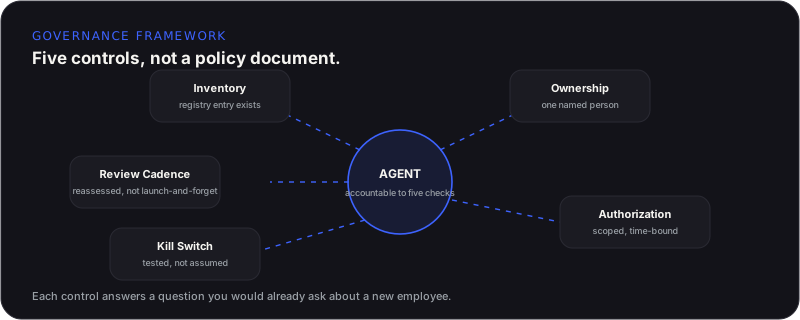
Governance is not a document that sits in a shared drive. It is a small set of operational controls that answer the same questions you would already ask about any employee or service account with access to real systems.
- Inventory: a current, accurate list of every agent running in the business, what it does, and what it can touch
- Ownership: a named person accountable for each agent, who can explain what it is authorized to do and answer for what it has done
- Authorization boundaries: explicit limits on what each agent can act on, reviewed and reissued rather than granted once and forgotten
- A kill switch: a fast, reliable way to pause or shut down a specific agent without taking down the systems around it
- A review cadence: a scheduled point where each agent gets re-evaluated, not just launched once and left running indefinitely
Governance vs Security vs Observability: Three Different Questions
These three get used interchangeably, and that confusion is part of why governance gets skipped. Each one answers something the other two do not.
- Security asks: can this agent be manipulated into doing something it should not, through prompt injection or a compromised tool, and what stops that if it happens
- Observability asks: what did this agent actually do on a given run, and can I trace the decision that led to the result
- Governance asks: who is accountable for this agent existing at all, what is it authorized to touch, and who can stop it right now if it needs to stop
A business can have strong security and full observability on a single agent and still have zero governance, because nobody owns the decision to keep running it, nobody reviews its access on a schedule, and nobody has tested whether it can actually be shut down under pressure. All three layers are needed. Governance is the one most businesses build last, if they build it at all.
The Agent Registry: Where Governance Actually Starts
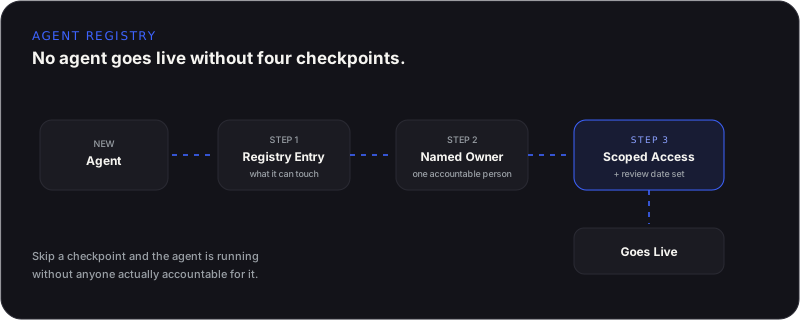
Before writing a single policy, build a list. An agent registry is a simple, current record of every agent running in the business: what it is called, what it does, what systems it can reach, who owns it, and when its access was last reviewed. Most businesses that think they have a governance problem actually have a visibility problem first. They cannot govern what they cannot enumerate, and by the time someone tries to answer "how many agents do we have running right now," the honest answer is often "we are not sure."
This becomes urgent fast once a business moves past a single agent. A multi-agent setup multiplies the number of things touching production systems, and each new agent added without a corresponding registry entry is one more thing nobody can fully account for. The registry does not need to be sophisticated. It needs to exist, and it needs to be kept current, which is a discipline problem more than a technical one.
Ownership Has to Be a Person, Not a Team
A common failure mode is assigning agent ownership to a team or a department instead of a named individual. "Engineering owns it" is not accountability, because when something goes wrong, nobody in particular has to answer for it, and no one in particular is checking its access on a schedule. Every agent with access to a real system should have one named owner who can explain, on short notice, what it is authorized to do, why it has that access, and what it has done recently. That is the same standard applied to any other identity with standing access, and agents deserve the same rigor, not less, because they act faster and at higher volume than a person would.
Build the Kill Switch Before You Need It
The most telling governance gap in most businesses is not a missing policy, it is an untested kill switch. Being able to shut down a specific agent, cleanly and quickly, without taking down the systems it connects to, sounds basic and is routinely missing in practice. If the honest answer to "how would we stop this agent right now" is "we are not sure, we would probably have to pull credentials or take the whole integration offline," that is not a control, it is a hope. Test it before you need it, the same way you would test a rollback plan before you actually need to roll back.
A Governance Checklist Before You Scale Past One Agent
- A current registry exists listing every agent, what it does, and what it can touch
- Every agent has one named owner, not a team, who can account for it on short notice
- Access is scoped and time-bound, reissued on a schedule rather than granted once and left standing
- A tested kill switch exists for each agent, and someone has actually run it, not just documented it
- Each agent has a scheduled review date, not an indefinite "it works, leave it running" status
- Governance ownership sits with a named person or role in the business, distinct from whoever built the agent
How We Approach This at Agentiq Studios
When we help a client move an agent from pilot to production, governance is part of the readiness conversation alongside security and observability, not a separate compliance step bolted on afterward. That usually starts with an infrastructure audit that produces the registry most businesses do not have: what is actually running, what it touches, and who should own it going forward. From there, we help design the authorization boundaries and review cadence into the architecture itself, so ownership is a structural part of the system rather than a policy nobody rereads after launch.
Related from Agentiq Studios: AI Infrastructure Audit, AI Architecture Design, Agentic Processes, and industry pages for Finance and Healthcare, where governance is usually a compliance requirement, not a nice-to-have.
Final Thoughts
Most businesses stuck between piloting agents and running them at real scale are not blocked by model quality. They are blocked by not being able to say, with confidence, what is running, who owns it, and how to stop it. Governance is not paperwork layered on top of good engineering, it is the accountability structure that lets good engineering scale past one agent without turning into unmanaged risk. Build the registry, name real owners, scope access on a schedule, and test the kill switch before you need it. That is what lets the rest of the agent program grow safely instead of quietly outrunning anyone's ability to account for it.