Build vs Buy AI Agents: A Practical Decision Guide
What you'll learn
- The real cost difference between building and buying AI agents
- When buying a platform is the safer, faster bet
- When building in-house actually pays off
- A simple framework for making the call
- Why most businesses land on a hybrid approach
- The hidden costs neither side puts in the pitch
Buy an AI agent platform when the workflow is common and vendors already handle it well. Build one in-house when the workflow is core to how you compete, or depends on data and logic no vendor can replicate. Most businesses that get this decision right end up doing some of both: buying the foundation and building only the parts that create an edge.
TL;DR: buying is faster and cheaper to start, usually days to weeks and a few thousand dollars a month. Building is slower and more expensive upfront, often months and well into six figures, but it gives you full control over logic, data, and cost at scale. The right call depends on how standard the workflow is and how much it matters to your competitive position, not on which option sounds more impressive.
The Real Question Isn't Build or Buy
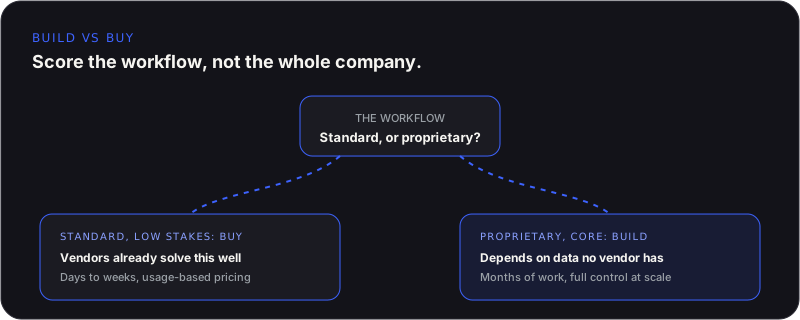
Most teams frame this as a single either-or decision for the whole company. That's the wrong scope. The better question is per workflow: does this specific agent need to be custom, or would a mature platform get us 90% of the way there? A support team answering common questions and a fintech team making credit decisions on proprietary risk models are not the same decision, even if both involve "an AI agent."
Treating build vs buy as one company-wide choice is how businesses end up either overbuilding a simple support bot from scratch, or trying to force a proprietary, high-stakes process into a generic platform that was never designed for it.
What Buying Actually Gets You
Buying means adopting a vendor platform (an agent builder, a managed AI product, or a point solution) and configuring it for your workflow instead of writing the underlying agent logic yourself.
- Speed: a managed platform can be live in days to a few weeks, not months
- Predictable, usage-based pricing instead of a large upfront engineering bill
- Managed infrastructure: uptime, model updates, and evaluation tooling are the vendor's problem
- Faster access to a working system, so you get real usage data sooner
- Lower risk for a first attempt at a workflow you're not certain about yet
Buying is the right default for common, well-understood workflows: general customer support, meeting notes, basic document summarization, scheduling. Vendors have already solved these problems for hundreds of other companies, and you gain nothing by re-solving them yourself.
When Building Makes Sense
Building in-house is justified when the agent touches something a vendor platform genuinely cannot replicate: proprietary data, a regulated decision process, or a workflow that is directly tied to why customers choose you over a competitor.
- The workflow depends on proprietary data, models, or business rules a vendor doesn't have access to
- The process is core to your competitive differentiation, not a shared industry problem
- You need deep, non-standard integrations with internal systems a generic platform won't reach cleanly
- Compliance or data residency requirements rule out sending data to a third-party platform
- You expect high, stable volume where a custom, tuned system lowers cost per interaction over time
The Costs Nobody Puts in the Pitch Deck
Vendor demos make buying look simple, and engineering estimates make building look like a fixed one-time cost. Neither picture is complete. Gartner predicts over 40% of agentic AI projects will be canceled by the end of 2027, and the reasons it cites, escalating costs, unclear business value, and inadequate risk controls, are exactly the costs that don’t make it into a first quote.
- Buying: setup is fast, but usage-based pricing scales with volume, and you're dependent on the vendor's roadmap, uptime, and pricing changes
- Building: initial development is often less than a third of the real lifetime cost. Data preparation, evaluation, and retraining eat the rest
- Building: teams consistently underestimate ongoing maintenance, security patching, and the cost of keeping up with model changes
- Both: talent is the hidden line item. Reliable, production-grade agents require prompt engineering, evaluation, guardrail design, and hallucination management, skills most internal engineering teams don't have yet
This is the same trap we cover in our guide to why businesses overpay for AI: the sticker price is never the real number. What matters is the total cost per outcome, six months and a year in, not the number in the first quote.
A Simple Framework: Capability, Complexity, Criticality
Before deciding, score the specific workflow, not the whole company, on three questions.
- Capability: do we have, or can we get, the internal talent to build and maintain this reliably?
- Complexity: is this a standard, widely solved workflow, or does it depend on proprietary logic and data?
- Criticality: how central is this workflow to our competitive advantage, and what happens if it fails or leaks?
Low scores across the board point to buy. A workflow that scores high on complexity and criticality, where the capability gap is closeable, points to build. Most real answers land in the middle, which is exactly where the hybrid approach comes in.
The Hybrid Approach Most Businesses Land On
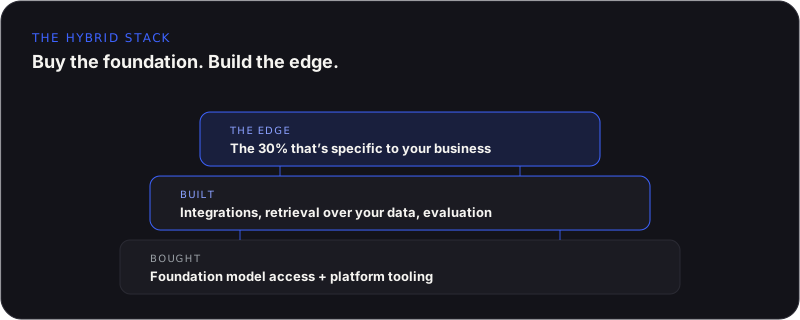
Very few companies are pure builders or pure buyers once they've run a few workflows through this decision. The common pattern: buy the foundation model access and the general-purpose tooling, then build the orchestration, integrations, and evaluation layer that makes the system actually reliable for your business. A platform can get a workflow 70% of the way there; the remaining 30%, custom prompts, retrieval over your own data, specific integrations, human-in-the-loop checkpoints, is where the real value and the real risk live.
A useful analogy: buying the platform is like buying a car instead of building an engine from scratch. Building the orchestration and integration layer is like customizing that car for a specific job, like adding refrigeration for food delivery. You don't need to build the engine to justify customizing the vehicle for your actual use case.
A Short Checklist Before You Commit
- Does a mature vendor already solve this exact workflow for companies like yours? If yes, lean buy
- Does the workflow depend on proprietary data or logic a vendor can't access? If yes, lean build
- Do you need a working system in weeks, not months? If yes, lean buy first, then reassess
- Would failure or a data leak here cause real business or compliance damage? If yes, weigh building or a tightly scoped hybrid
- Do you have, or can you hire, the specific AI engineering skills this requires? If no, buying or partnering reduces execution risk
- Is volume high and stable enough that a custom, tuned system would meaningfully lower cost per interaction? If yes, building starts to pay for itself
How We Approach This at Agentiq Studios
When a business comes to us wanting a custom AI agent, one of the first things we do is challenge that assumption. Sometimes the right answer really is a fast, well-configured platform, and we'll say so. Other times the workflow is proprietary enough, or important enough, that a custom build is the only option that actually protects the business. We'd rather scope the decision correctly up front than sell a bigger build than the workflow needs.
Related from Agentiq Studios: AI Agent Development, AI Strategy Consulting, Agentic Processes, and Retail & E-commerce, where build-vs-buy comes up constantly for support and personalization agents.
Final Thoughts
Build vs buy isn't a one-time, company-wide decision. It's a question you should be asking for every workflow you consider automating with AI. Score the workflow honestly on capability, complexity, and criticality, start with buying where it's standard and low-stakes, and reserve custom builds for the parts of the business that actually depend on being different from everyone else. Get that scoping right, and you avoid both the overbuilt support bot and the underbuilt system handling something that mattered too much to leave to a generic platform.