AI Agents vs AI Automation: What's the Difference?
What you'll learn
- AI Agents vs traditional automation
- When AI actually adds value
- Common business use cases
- How to avoid over-engineering your AI projects
Most businesses come to us asking for “AI.” The interesting part? After a 30-minute conversation, we often realize they don’t actually need AI. They need automation. Or sometimes, they need both.
Some businesses spend thousands of dollars every month running powerful AI models for tasks that could have been handled with a simple workflow. Others build automations for problems that actually require AI reasoning. Knowing the difference can save you a significant amount of money, not just during development, but every month after deployment.
TL;DR: automation follows fixed rules and is cheap to run at any volume. An AI agent reasons through open-ended situations and costs more per request, because every request calls a model. Use automation for anything predictable, and reserve AI agents for work that requires judgment, research, or handling questions with no single right answer. Most valuable systems combine both instead of picking one.
What Is AI Automation?
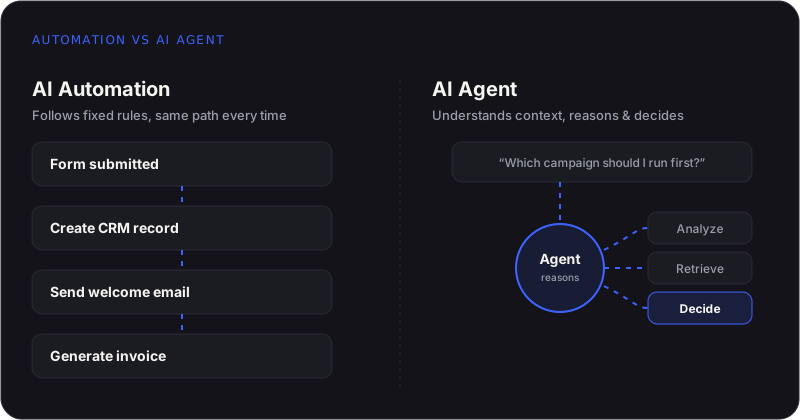
Think of automation as following a checklist. If something always happens the same way, automation is usually enough.
- When a customer fills out a form, create a lead in your CRM
- Send a welcome email
- Create a Slack notification
- Generate an invoice
- Schedule a follow-up task
There’s no thinking involved. The system simply follows predefined rules. Automation is fast, reliable, and inexpensive, and in many businesses it removes hours of repetitive work every day. TechTarget frames the underlying split well: traditional automation excels at structured data and predefined workflows, while agentic systems are built for the unstructured, judgment-heavy work that breaks a fixed script.
What Is an AI Agent?
Now imagine the task isn’t predictable. Instead of following rules, the system has to make decisions. A customer asks, “I’m launching a new skincare brand. Which campaign should I run first?” There isn’t one fixed answer.
The AI needs to understand the question, analyze context, retrieve information, and generate a useful response. That’s where AI agents become valuable. They don’t just follow instructions, they reason, adapt, and make decisions based on available information.
A Simple Example
Imagine someone joins your company. Traditional automation creates an email account, adds them to Slack, sends onboarding documents, schedules orientation, and notifies HR. Every employee receives exactly the same process.
An AI agent is different. When the new hire asks, “I’m joining the engineering team. Where can I find our deployment process?” the AI searches your internal documentation, finds the latest guide, summarizes it, explains company terminology, and answers follow-up questions. That’s something traditional automation simply can’t do.
The Biggest Mistake Businesses Make
Many companies assume AI should replace every workflow. It shouldn’t. If your business already knows exactly what needs to happen, you probably don’t need AI, you need automation. Using AI for simple repetitive tasks is like hiring a senior consultant to press a button all day. It works, but it’s unnecessarily expensive.
Where AI Creates Real Value
AI becomes valuable when work involves uncertainty:
- Researching information
- Writing content
- Summarizing documents
- Understanding customer questions
- Analyzing large amounts of data
- Finding information across multiple systems
- Making recommendations
- Planning complex workflows
Whenever the system needs to “think,” AI is usually the right choice.
The Best Businesses Use Both
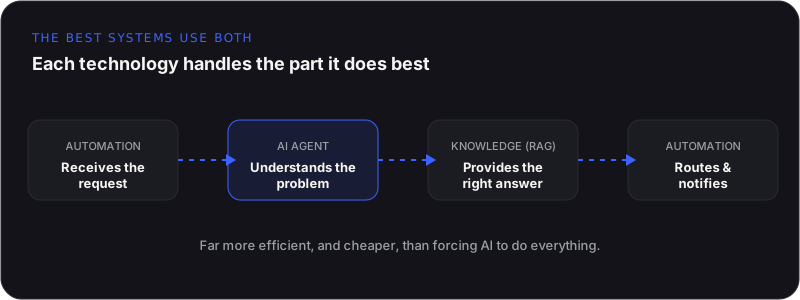
The most successful AI implementations combine automation with AI instead of choosing one or the other. A customer submits a support request: automation receives the form, an AI agent understands the problem, a knowledge base provides the right information, and automation creates a ticket and notifies the right department if a human is needed. Each technology handles the part it’s best at, far more efficient than forcing AI to do everything.
Why This Matters for Cost
Every unnecessary AI request costs money. If your system sends thousands of requests every day to a premium model, even for simple tasks, those costs grow quickly. A smarter architecture uses automation where rules exist, AI only where reasoning is required, retrieval systems to avoid unnecessary processing, and smaller or self-hosted models whenever they deliver the same result. We cover this trade-off in more depth in why most businesses overpay for AI, since the pattern that inflates AI bills is almost always architecture, not the model itself.
How We Approach It at Agentiq Studios
One of the first questions we ask isn’t “Which AI model do you want to use?” It’s “Does this problem actually need AI?” Sometimes the answer is yes, sometimes no, and sometimes the best solution is a combination of automation, AI agents, knowledge systems, and integrations. Choosing the right architecture is often more important than choosing the newest model. That question is the starting point of our AI Strategy & Consulting work, before any build decision gets made.
Related from Agentiq Studios: AI Agent Development, AI Workflow Automation, and Agentic Processes.
Final Thoughts
AI isn’t replacing automation, and automation isn’t replacing AI, they solve different problems. The businesses seeing the biggest results aren’t chasing the latest trend. They’re building systems where every technology has a clear purpose. That’s how you create AI that’s faster, more reliable, and significantly more affordable to operate.