How to Measure AI Agent ROI (Without Guessing)
What you'll learn
- The real ROI formula for AI agents, not just time saved
- Why you need a documented baseline before you deploy anything
- What counts as cost beyond the model bill
- The measurement window that actually proves payback
- How to tell the difference between a vanity metric and a real one
- When the numbers say stop, not scale
Most businesses cannot answer a simple question: is the AI agent we deployed actually making or saving money. Not because the agent failed, but because nobody wrote down what things looked like before it existed. If you want the direct answer on how to measure AI agent ROI, here it is. Capture a baseline before you deploy anything, count the full cost including the parts that never make it into the vendor pitch, and hold the agent to a fixed measurement window before you decide whether it worked.
TL;DR: AI agent ROI is net value divided by total cost, not time saved divided by nothing. Net value includes time removed, errors avoided, and revenue protected, not just a feeling that things are faster. Total cost includes the model bill, the integration work, and the humans reviewing its output. Measure over a fixed window, usually three to six months, against a documented baseline, or the number you report is a guess with a percentage sign on it.
Why Most AI Agent ROI Numbers Are Wrong
Ask a team how their AI agent is performing and you will usually hear a time-saved estimate: it saves us ten hours a week. That number is almost always invented after the fact, based on a guess about how long the task used to take, and it almost never subtracts what the agent costs to run. A number with no baseline and no cost side is not ROI. It is a hope, dressed up as a metric.
The businesses that get burned are the ones that scale an agent based on that kind of number, then discover six months later that the model bill, the review time, and the fixes for its mistakes cost more than the manual process ever did. Real measurement catches this before you scale, not after. Deloitte’s research on AI ROI found only 10% of organizations using agentic AI currently see significant, measurable returns, largely because AI is rarely deployed in isolation, which makes its actual contribution hard to isolate from everything else changing at the same time.
The Real ROI Formula
Net value is not just time saved. It is time removed from the workflow, plus errors and rework avoided, plus revenue protected or captured, plus any real quality gain, minus everything it cost to get there. If you only count saved time, you will overstate ROI and scale the wrong agent.
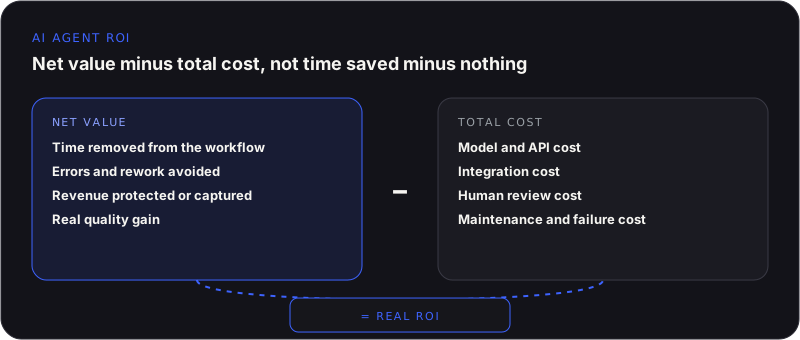
- Model and API cost: every request the agent sends, at your real production volume, not a demo volume
- Integration cost: connecting the agent to your systems, data, and existing workflows
- Human review cost: the time people spend checking, correcting, or approving what the agent produces
- Maintenance cost: prompt updates, monitoring, and fixes as your data and systems change
- Failure cost: what it costs when the agent gets something wrong, a bad answer sent to a customer, a wrong number in a report
Step 1: Document the Baseline Before You Deploy Anything
You cannot prove an agent saved time or money if you never measured the old way of doing it. Before deployment, write down how the workflow runs today. This takes an afternoon and it is the single highest-leverage step in the entire process, because every ROI number you produce later depends on it.
- How long the task currently takes, per unit of work, not a rough guess
- How many times it happens per week or month at current volume
- The current error or rework rate
- What it costs today, including the people currently doing it
- What "good" looks like, so you can tell if quality improves or slips
Step 2: Count the Full Cost, Not Just the Subscription
The sticker price of an agent is never the real number. This is the same trap we cover in why most businesses overpay for AI: the monthly platform fee or API bill is only one line item. The bigger costs usually show up later, in integration work, in the humans who still have to review what the agent produces, and in the maintenance it takes to keep it working as your business changes.
- A support agent that needs a human to check every third answer is not free labor, it is a different labor cost
- An agent connected to five internal systems has an integration and maintenance bill that a single-system agent does not
- A cheap model with a high error rate can cost more in rework than a more expensive model that gets it right the first time
- Costs that scale with volume can look small in a pilot and become significant at real production scale
Step 3: Pick a Measurement Window and Hold It
ROI is not a single number you check the week after launch. Give the agent a fixed measurement period, most businesses land on three to six months, and resist the urge to declare victory or failure in week two. Early weeks are noisy: people are still learning the tool, prompts are still being tuned, and usage patterns have not settled.
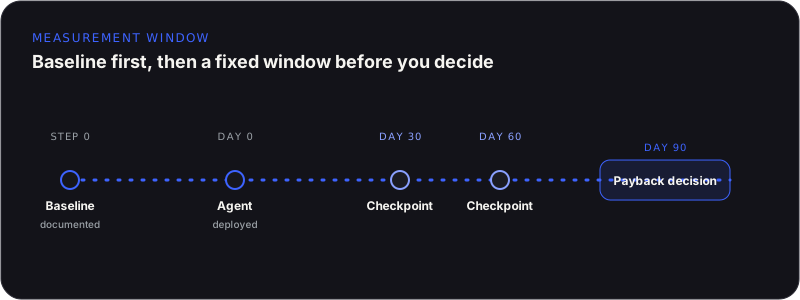
Check in at set intervals, commonly 30, 60, and 90 days, and compare each checkpoint against the same baseline you documented in step one. By the end of the window you should be able to say, in plain numbers, what changed and what it cost to change it. If you cannot, the window was not run properly and you are back to guessing.
Vanity Metrics vs Real ROI Metrics
- Vanity: "the agent handled 500 conversations" vs Real: "the agent resolved 500 conversations at a lower cost per resolution than our previous process, after subtracting review time"
- Vanity: "we launched an AI assistant" vs Real: "response time dropped from four hours to twelve minutes, measured against the documented baseline"
- Vanity: "the team loves it" vs Real: "hours previously spent on this task dropped by a measured amount, and those hours were reallocated to higher-value work"
- Vanity: time saved with no cost subtracted vs Real: net value after model cost, integration cost, and review cost are all subtracted
- Vanity: a number from week one vs Real: a number from the full measurement window, checked at fixed intervals
When the Numbers Say Stop, Not Scale
Disciplined measurement sometimes proves an agent is not worth scaling, and that is a good outcome, not a failed project. If the review cost and failure cost are eating most of the value the agent creates, the honest move is to fix the workflow, narrow the agent's scope, or pull it back, not to roll it out to more teams because the demo looked impressive. Killing an agent that does not pay off is cheaper than scaling one that does not.
This is also where attribution gets harder and more important. If you changed the agent and the process at the same time, you cannot cleanly credit the result to the AI. Keep the baseline clean and change one variable at a time wherever you can, so the number you report actually reflects what the agent did.
How We Approach ROI at Agentiq Studios
Before we build or deploy an agent for a client, we insist on documenting the baseline first, even when it is tempting to skip straight to building. It is the difference between a client being able to say exactly what an agent is worth six months in, versus arguing about impressions and vibes. A system that cannot be measured cannot be defended when someone asks whether it was worth the money.
Related from Agentiq Studios: AI Strategy & Consulting and Executive Dashboards.
Final Thoughts
AI agent ROI is not a mystery, it is a discipline most teams skip because measuring is less exciting than shipping. Write down the baseline before you deploy, count the full cost, and give the agent a real measurement window before you decide anything. Do that, and the decision to scale, adjust, or kill an agent stops being a debate and starts being a number everyone can agree on.