Multi-Agent Orchestration: Do You Actually Need It?
What you'll learn
- What multi-agent orchestration actually means
- The three coordination patterns businesses use in production
- How to tell if a workflow needs multiple agents or just one
- The coordination overhead that rarely makes it into the pitch
- A simple framework for deciding before you build
Multi-agent orchestration is a setup where several specialized AI agents, each built for one narrow job, work together on a task that no single agent could handle well alone, coordinated by a supervisor agent or a defined workflow instead of one model trying to do everything. If you are wondering whether your business needs this or whether one well-built agent is enough, the short answer is: most businesses do not need it yet, and building it before you need it usually creates more problems than it solves.
TL;DR: orchestration means multiple agents, each with a narrow job, coordinated by a supervisor or a defined workflow so the whole system produces one reliable result. It earns its complexity when a task genuinely spans multiple domains, needs parallel work, or requires a checkpoint before something risky happens. For a single workflow with one clear goal, a single well-built agent is almost always the better, cheaper, and more reliable choice.
What Multi-Agent Orchestration Actually Means
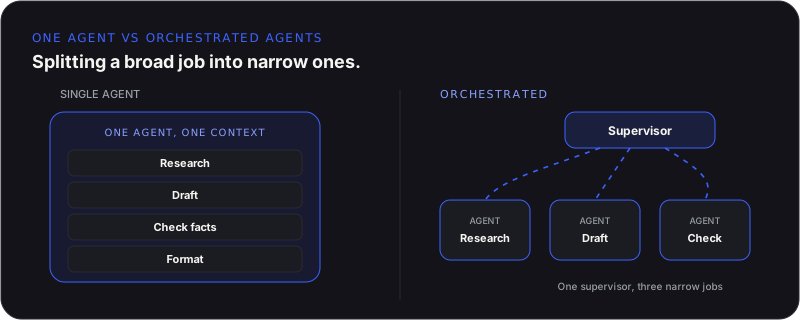
A single AI agent handles one job end to end: it reads a request, reasons about it, maybe calls a tool, and returns an answer. That works well until the job gets broad enough that one agent starts doing too much at once, researching, writing, checking facts, and formatting, all inside one context window with one set of instructions. Quality drops because the agent is context switching internally the same way a person would if asked to write a report, audit it, and approve it all in one sitting.
Orchestration splits that broad job into narrow ones. One agent researches. One agent drafts. One agent checks the draft against source material. A supervisor agent, or a fixed workflow, decides the order, passes work between them, and combines the results. Each agent gets a smaller, clearer job, which means simpler instructions, easier evaluation, and fewer ways for any one step to go wrong.
Single Agent vs Multi-Agent: The Real Difference
A single well-built agent and a multi-agent system are not different tiers of sophistication, they are different tools for different shapes of problem.
- A single agent has one job, one set of instructions, and one context. A multi-agent system has several agents, each with its own narrow job and its own context.
- A single agent is faster to build, easier to debug, and cheaper to run, since there is one thing to monitor and one place errors can occur.
- A multi-agent system costs more to build and run, since every agent adds its own model calls, but it can handle work that genuinely does not fit in one context or one skill set.
- A single agent tends to degrade quietly as scope creeps, doing more tasks less reliably. A multi-agent system holds up better as scope grows, provided the coordination layer is built well.
- A single agent fails in one place, which is easy to trace. A multi-agent system can fail at the handoff between agents, which is harder to diagnose without good logging.
Why This Is Becoming a 2026 Default for Complex Work
Gartner forecasts that 40% of enterprise applications will embed task-specific AI agents by the end of 2026, up from less than 5% in 2025, and Forrester’s 2026 predictions call 2026 the year enterprise software moves from single generalist agents to specialized agents coordinating under a central layer.
That shift is happening because the failure mode of single, do-everything agents is now well understood: they work in a demo and get unreliable in production, exactly when the job spans research, writing, verification, and action in one pass. Splitting that job across agents with narrower scope is proving to be a more reliable path to production than making one agent bigger and giving it a longer prompt.
The Three Coordination Patterns Worth Knowing
Most production multi-agent systems use one of three patterns, or a combination.
- Sequential handoff: agents run in a fixed order, each one passing its output to the next, like an assembly line. A research agent hands its findings to a writing agent, which hands a draft to a review agent. Simple to reason about, good for workflows with a clear, repeatable order of steps.
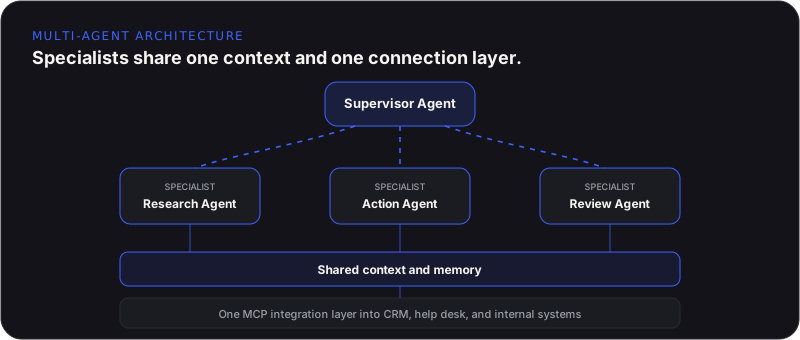
- Supervisor and specialists: one supervisor agent breaks a request into subtasks, routes each one to the specialist agent built for it, and assembles the final result. This handles work where the right next step depends on what came before, not a fixed sequence.
- Peer collaboration: agents can call on each other directly as needed, rather than passing through a fixed order or a single supervisor. This is the most flexible pattern and also the hardest to keep predictable, since more paths between agents means more places a conversation can go off track.
When You Actually Need Multi-Agent Orchestration
- The task genuinely spans multiple domains that need different skills, tools, or data sources, not just multiple steps a single agent could still hold in one context.
- Parts of the work can run in parallel, and doing them in parallel meaningfully cuts the time to a result.
- The workflow needs a distinct verification or approval step before an irreversible action, like sending money, publishing content, or changing a customer record.
- You need the same specialist capability, like a document-search agent, reused across several different workflows instead of rebuilt inside each one.
- A single agent has been in production, has hit a clear reliability ceiling from doing too much in one context, and you can point to specifically where it breaks.
When a Single Agent Is Still the Better Choice
- The workflow has one clear goal and a bounded set of steps a single agent can hold in context without losing track of earlier instructions.
- You have not yet run a single agent in production long enough to know where it actually struggles. Orchestration solves problems you can observe, not problems you are anticipating.
- Latency matters. Every handoff between agents adds a round trip, and a chain of agents is slower than one agent doing the same work directly.
- The team maintaining this system is small. Multi-agent systems multiply the places that need monitoring, evaluation, and debugging, and that overhead needs owners.
- The budget for this workflow is tight. More agents means more model calls for the same underlying task, and that cost compounds at volume.
The Hidden Cost: Coordination Overhead
The part that rarely makes it into a multi-agent pitch is what it costs to keep several agents working from the same picture of reality. Each agent needs the right context passed to it at the right time, which usually means a shared memory or retrieval layer sitting underneath the whole system, not just underneath one agent. Without that, agents drift out of sync, one agent acts on stale information, and the system produces confidently wrong results that are much harder to catch than a single agent simply saying it does not know.
This is also where a standard integration layer starts to matter. If your specialist agents each need to read from or act on the same business systems, giving them a consistent way to do that, rather than a different custom integration per agent, is exactly the problem an MCP server is built to solve. Orchestration multiplies the number of agents touching your systems, so the case for a standardized, permissioned connection layer gets stronger, not weaker, as you add agents.
Debugging also gets harder. When one agent fails, you look in one place. When a five-agent pipeline produces a wrong answer, the fault could be in the handoff, in one agent's narrow reasoning, or in shared context that went stale between steps. Systems like this need real observability, tracing what each agent saw and did, built in from the start, not added after the first confusing failure.
A Simple Framework Before You Build
Before adding a second agent to anything, answer three questions honestly.
- Domain: does this genuinely require different skills, tools, or knowledge that do not fit cleanly in one agent's context, or am I just describing multiple steps a single agent could still do?
- Ceiling: has a single agent actually run in production and hit a specific, observable reliability limit, or is this orchestration built to solve a problem you expect rather than one you have measured?
- Ownership: does someone on the team have the time and the tooling to monitor coordination between agents, not just each agent individually, since that is where multi-agent systems actually break?
If the honest answers point to a real cross-domain problem, a measured ceiling, and a clear owner, orchestration is worth the added cost and complexity. If any of the three is shaky, a single, well-scoped agent, built and measured properly, is almost always the better next step, and it is also a stronger foundation to expand from later, since a solid single agent tends to become a solid specialist inside a bigger system when the time actually comes.
How We Approach This at Agentiq Studios
When a client asks us to build a multi-agent system, one of our first questions is whether they have run a single-agent version of this workflow yet. Often they have not, and that single-agent version turns out to be enough, or it surfaces exactly where the real complexity lives before anyone commits to a five-agent architecture to solve a problem that a better single agent, or a bit of retrieval, would have handled. We would rather ship the simpler system that works than the more impressive one that is harder to maintain and debug in production. This is the same discipline we apply when we help clients decide between building and buying an agent in the first place: match the architecture to the actual shape of the problem, not to what sounds more advanced.
Related from Agentiq Studios: AI Agent Development, AI Architecture Design, Agentic Processes, and industry pages for Manufacturing and Logistics, where coordinating multiple systems is the whole problem.
Final Thoughts
Multi-agent orchestration is a real, increasingly production-ready pattern, not a fad, and 2026 is the year it is genuinely moving past pilots for a meaningful share of enterprises. But it solves a specific kind of problem: work that spans real domains, needs real parallelism, or needs a real checkpoint before something risky happens. It is not a more sophisticated default to reach for before you have proven a single agent cannot do the job. Start with one well-built, well-measured agent, let production use show you exactly where it runs out of road, and add coordination only where the evidence says you need it. That is how you end up with a system that is genuinely more capable, instead of one that is just more expensive to run and harder to debug.