What Is Shadow AI? A Guide for Business Owners
What you'll learn
- What shadow AI actually means, and how it differs from traditional shadow IT
- How widespread unauthorized AI tool use already is, based on a 2026 employer survey
- Why the risk is different from other unsanctioned software: submitted data cannot be recalled
- Why banning AI tools outright tends to make the problem harder to see, not smaller
- What actually reduces shadow AI risk: inventory, sanctioned alternatives, and ongoing visibility
- The first practical step to take this month, even without a dedicated security team
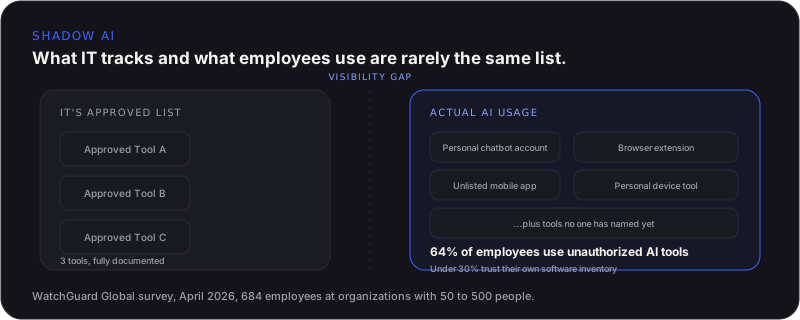
Shadow AI is any AI tool, model, or browser-based assistant employees use for work without security review or IT approval, from a free chatbot that gets pasted with client data to an unlisted browser extension summarizing internal documents. It is not a hypothetical risk sitting somewhere in the future. A WatchGuard Global survey of 684 employees at organizations with 50 to 500 employees, run in April 2026, found that 64% admit to using unauthorized AI tools for work. That number does not move because a business decides to write a policy. It is already true today, whether the policy exists or not.
TL;DR: shadow AI is unsanctioned AI use inside your business, and it is already happening whether you have addressed it or not. The same WatchGuard survey found that under 30% of employees believe their organization keeps an accurate inventory of the software in use, and close to 40% say their company lacks full visibility into the applications employees actually rely on. Banning tools outright does not close that gap, because employees adopt them for speed, not defiance. What actually works is building a real inventory, giving people a sanctioned option that is just as fast, and treating AI tool access with the same discipline you would apply to any other system that touches company data.
Why Shadow AI Spreads Faster Than Most Policies
Employees are not sneaking around IT out of malice. They are choosing the tool that gets the job done in the next five minutes. A free AI chatbot requires no installation, no procurement request, and no waiting on an approval queue, and its output is often indistinguishable from something a person spent an hour producing. When no sanctioned option exists that competes on speed, people default to whatever is already open in another browser tab. "Organizations are investing in security tools, but many still lack visibility into how employees actually work," said Marc Laliberte, Director of Security Operations at WatchGuard, commenting on the survey. That gap between what a business assumes is running and what is actually running is the entire shadow AI problem in one sentence.
Shadow AI vs Shadow IT: Why the Old Playbook Falls Short
Shadow IT and shadow AI sound like the same problem with a different label, but the risk profile is not the same, and treating them identically leaves the harder half unmanaged.
- Shadow IT: an unauthorized app or device on the network. Once discovered, it can usually be located, restricted, or removed, and the exposure ends there.
- Shadow AI: unauthorized use of a service, often through a personal account in a browser tab rather than an installed program, which means it rarely shows up in a standard software inventory at all.
- Shadow IT risk is mostly about an unmanaged footprint: unpatched software, unmonitored access, orphaned accounts.
- Shadow AI risk includes something shadow IT usually does not: once data is submitted to an external model or service, it cannot be pulled back the way you could revoke a shared link or wipe a device. The exposure does not end when the tool is discovered, because the data already left.
The Real Risks of Unmanaged AI Use
The risk is not that employees are experimenting with AI. It is that nobody in the business can currently answer basic questions about what left, where it went, and whether it was allowed to.
- Data exposure: client information, financial figures, or proprietary code get pasted into a tool with no contractual security guarantee and no audit trail back to the business.
- Compliance exposure: in regulated industries like healthcare, finance, and legal, a compliance obligation can be violated the moment sensitive data leaves an approved boundary, regardless of intent.
- No paper trail: without an inventory, a business cannot answer "what AI tools touched customer data this quarter" if a regulator, auditor, or client asks.
- Irreversible disclosure: unlike a file on a shared drive, data submitted to an external AI service typically cannot be recalled, deleted on demand, or fully audited after the fact.
Why Banning AI Tools Does Not Work
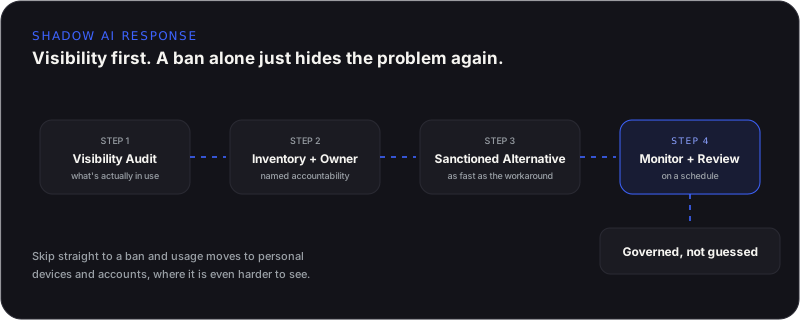
The instinct to block every unapproved AI tool at the network level is understandable and usually backfires. Employees under deadline pressure route around a block by switching to a personal device or a personal account, both of which are invisible to the business, which makes the visibility problem worse, not better. The more durable approach, as one 2026 governance analysis put it, is to create a narrow approved pathway for legitimate business usage so employees are not forced into workarounds. A ban without an alternative is a policy. A sanctioned option that is fast enough to actually get used is a control.
What Actually Reduces Shadow AI Risk
The practical response looks less like a security lockdown and more like extending the same discipline a business already applies to other systems that touch its data.
- Build a real inventory of which AI tools are approved, for what purpose, and under what access controls, rather than assuming the last policy memo covers what is actually in use.
- Give employees a sanctioned alternative that is genuinely as fast as the unauthorized option, since a slower approved tool gets routed around within a week.
- Apply role-based access so only the people who need it can use AI tools against sensitive data, instead of an all-or-nothing policy.
- Monitor actual usage, not just what is registered, since most shadow AI activity happens in a browser tab rather than an installed application that shows up on a standard device scan.
- Audit on a schedule and look past the obvious tools, since new ones appear faster than any static list can keep up with.
Shadow AI vs AI Agent Governance: Related, Not the Same
These two get confused because both are about AI a business does not fully control, but they describe different populations. AI agent governance is about the agents your business deliberately built or deployed: who owns them, what they can touch, and how they get shut down. Shadow AI is about the tools nobody deployed at all, the ones employees adopted on their own because they were fast and free. A business can have excellent governance over the three agents it built and still have zero visibility into the dozen unauthorized tools its team uses every day. Both need attention, and they need it through different processes.
How We Approach This at Agentiq Studios
When we run an infrastructure audit for a client, shadow AI visibility is part of the baseline, not an afterthought bolted on once something has already gone wrong. That starts with an honest inventory of what AI tools are actually in use across the business, not just what was formally approved, followed by a sanctioned path for the legitimate use cases that surface, so people have a reason to stop routing around IT. From there, the same ownership and review discipline we build into agent governance work extends naturally to cover AI tool access more broadly.
Related from Agentiq Studios: AI Strategy & Consulting (/services/ai-strategy-consulting), AI Infrastructure Audit (/services/ai-infrastructure-audit).
Final Thoughts
Shadow AI is not a future risk to plan for. It is a current condition inside most businesses, including yours, whether or not anyone has measured it yet. The instinct to respond with a ban is understandable and rarely works, because it removes the visibility a business needs at the exact moment it needs more of it. The businesses managing this well are not the ones with the strictest policy. They are the ones that ran an honest visibility audit first, built an inventory of what is actually in use, and gave their people a sanctioned option fast enough that there is no reason left to work around it.