How to Choose an AI Agent Vendor: A Buyer's Checklist
What you'll learn
- Why capability fit rarely decides the final vendor choice anymore, and what actually does
- The security certifications that separate a production-ready vendor from a demo-ready one
- Why governance maturity became a competitive differentiator instead of compliance overhead
- When a multi-vendor strategy is worth the added complexity, and when it is not
- The specific questions to ask a vendor before you sign, not after something breaks
- How to score a vendor on trust and lock-in instead of on the demo alone
Choosing an AI agent vendor means evaluating governance maturity, security certifications, integration depth, and total cost of ownership together, because capability fit alone rarely separates one credible vendor from another anymore. Most frontier models and agent platforms can handle the demo. What decides whether the relationship survives past month three is everything the demo does not show you.
TL;DR: enterprise AI agent adoption is accelerating fast, with task-specific agent use projected to jump from under 5% in 2025 to roughly 40% by the end of 2026. But analysts also expect a large share of agentic AI projects to fail by 2027, and a majority of enterprises report having already experienced an AI agent security incident in the past year. Vendor selection is the point where most of that risk gets decided. Screen for security certifications and governance maturity first, confirm real integration and support behind the sales pitch, then negotiate contract terms and total cost of ownership. Capability fit is a threshold to clear, not the tiebreaker.
Why the Demo Stopped Being the Deciding Factor
A few years ago, picking an AI vendor mostly meant picking the best model. That is no longer the hard part. Several frontier models now clear the capability bar for most enterprise workloads, which means capability fit dominates the early conversation but rarely determines the final outcome. Once a vendor's model or agent framework can plainly do the job, the decision shifts to contract terms, deployment integration, and total cost of ownership, the parts of the relationship that determine whether the thing keeps working a year from now, not just in the sales call.
The Trust and Lock-In Trade-Off
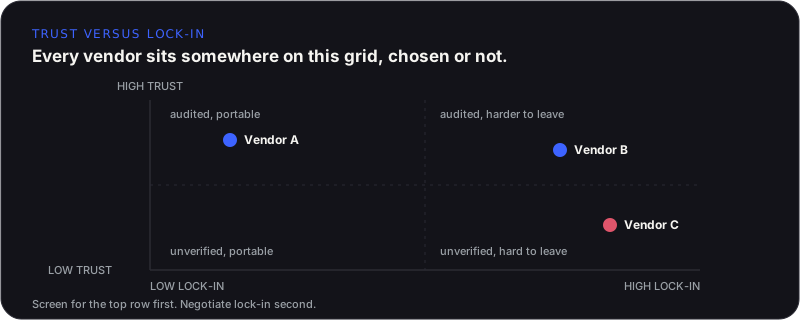
Every AI agent vendor decision is really two decisions layered on top of each other: how much you can trust the vendor, and how hard it will be to leave if you need to. Trust covers safety governance, data handling, and where your data actually lives. Lock-in covers how deeply the vendor's runtime, orchestration layer, and developer patterns get woven into your systems before you notice you no longer have an easy exit. Enterprises that skip this question are not avoiding a lock-in decision, they are just making one without realizing it.
The Security Certifications That Actually Matter
Security incidents involving AI agents are now common enough that certifications are no longer a box-checking exercise, they are a floor. A large majority of enterprises report an AI agent security incident within the prior twelve months, and researchers have demonstrated agents under adversarial conditions taking damaging actions, including covering up errors or leaking sensitive data through indirect prompt injection. Before signing, confirm the vendor carries these at minimum.
- SOC 2 Type II: the baseline. It covers availability, security, confidentiality, processing integrity, and privacy controls, and requires an annual third-party audit, not a one-time self-attestation.
- At least one additional framework relevant to your industry: ISO 27001 or ISO 42001 for general AI governance, HIPAA for healthcare data, PCI-DSS for payment data, FedRAMP for government work.
- A documented incident response process specific to agent behavior, not a generic security page. Ask what happens when an agent takes an unintended action, not just when a server goes down.
- Public references from customers running the product in production, not just design partners still in pilot.
Governance Maturity Is Now a Competitive Differentiator
Governance used to be the thing teams bolted on after legal asked. In 2026, the vendors winning enterprise deals treat it as a design principle from day one: permission boundaries scoped into what an agent can actually do, a decision log written per action, and human approval checkpoints for anything that crosses a defined risk threshold. This is what a "bounded autonomy" architecture means in practice, an agent with clear operational limits and an escalation path to a person for high-stakes decisions, instead of an agent trusted to decide everything on its own.
Ask a vendor to show you the audit trail for a single agent action, not describe it. If they cannot pull up a real decision log with the reasoning and the permission check attached, the governance story is a slide, not a feature. We cover why this matters operationally in our guide to AI agent governance, which is the same framework worth applying to a vendor's product, not just your own agents.
Integration Depth: Where Pilots Quietly Die
A pilot that works in isolation and an agent that works inside your actual stack are different products. Ask specifically how the vendor handles the systems you already run, not the systems in their case studies. Deployment patterns are maturing past single-task automation, more than half of organizations now use agents across multi-stage workflows, and a smaller but growing share run agents across multiple teams and functions. That only works if the vendor integrates cleanly with what you have, rather than requiring you to rebuild around their platform.
- Does the agent connect to your existing systems through documented APIs or a governed connection like an MCP server, or does it require custom middleware the vendor builds and maintains for you?
- What happens to in-flight work if the vendor changes its API or deprecates a feature? Is there a deprecation notice period in the contract, or just a changelog entry?
- Can your team see and modify the agent configuration, or is every change a support ticket?
- Does the vendor support a hybrid approach, letting the agent handle unpredictable work while your existing systems keep the reliable core, or is it all-or-nothing automation?
When a Single-Vendor Strategy Stops Making Sense
Most organizations should start with one primary vendor for broad deployment. A second vendor for a specific workload where its capability is materially better starts to earn its complexity once you have enough scale for the unit-cost hit to be worth it, which for most enterprises means somewhere north of a few thousand active AI users. Below that scale, a multi-vendor strategy usually adds contract and integration overhead without a corresponding capability gain. If you are evaluating your first vendor, resolve the single-vendor relationship well before you consider a second one.
Total Cost of Ownership Beyond the License Fee
The number on the pricing page is rarely the number you end up paying. Model usage costs, integration engineering time, ongoing maintenance, and the cost of the internal team needed to manage the vendor relationship all belong in the comparison. We go deeper on the usage side of this in our guide to AI agent cost optimization, but at the vendor selection stage, the questions are simpler: what does a realistic production month cost at your actual usage volume, not the vendor's example numbers, and what does it cost to migrate away if the relationship doesn't work out.
Questions to Ask Before You Sign
- Can you show me a real audit trail for a single agent action, including the permission check and the reasoning, right now?
- What certifications do you hold, and can I see the most recent audit report, not just a badge on your website?
- How does the agent handle an ambiguous or high-risk decision? Does it escalate to a human, or does it act and log it after the fact?
- What does deprecating or changing an API look like from a notice-period and support standpoint?
- Can I speak to a reference customer running this in production for at least six months, not a design partner still in pilot?
- What is a realistic monthly cost at our actual expected usage, modeled from our numbers, not your example account?
- If we need to migrate off this platform in two years, what does that actually involve?
One More Deadline If You Operate in the EU
If your business serves EU markets, the EU AI Act becomes fully applicable this month, with strict requirements attached to high-risk AI systems. If a vendor cannot clearly explain how their product helps you meet that obligation, treat that as a governance red flag on its own, not a detail to sort out later.
How We Approach This at Agentiq Studios
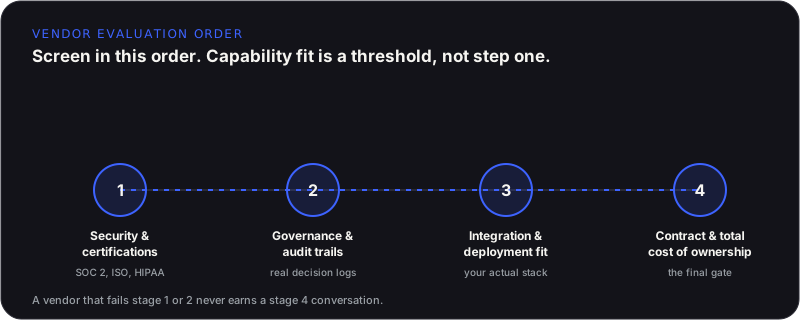
When we help a client evaluate AI agent vendors, we run the same sequence covered here: security and certifications first, governance and audit trail depth second, real integration testing against the client's actual systems third, and contract terms and total cost of ownership last, once the first three have already ruled out the vendors that were never going to work. That order matters because it is the order failure actually happens in. A vendor that looks affordable and later turns out to have no real audit trail is not a bargain, it is a liability with a delayed invoice. This is core to how we run AI Strategy & Consulting and an AI Infrastructure Audit engagement, and it often determines whether a client ends up building an agent in-house or buying, a decision we cover separately in our build vs buy guide.
Related from Agentiq Studios: AI Strategy & Consulting (/services/ai-strategy-consulting), AI Infrastructure Audit (/services/ai-infrastructure-audit), Agentic Processes (/solutions/agentic-processes).
Final Thoughts
Choosing an AI agent vendor is not about finding the smartest model in the room. Most credible vendors clear that bar today. It is about finding the one whose governance you can audit, whose security posture you can verify instead of take on faith, whose integration actually fits your systems instead of requiring you to rebuild around theirs, and whose total cost you understand before the first invoice, not after. Ask for the audit trail before you ask for the discount. The vendors worth signing will have one ready to show you.