Why 40% of AI Agent Projects Get Canceled
What you'll learn
- Why Gartner predicts over 40% of agentic AI projects will be canceled by the end of 2027
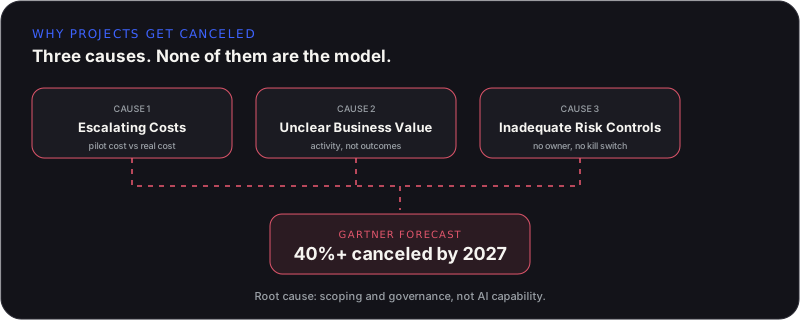
- The three reasons Gartner cites most often: escalating costs, unclear business value, and inadequate risk controls
- What "agent washing" is and why it inflates the number of projects doomed from the start
- Gartner's framework for choosing between an agent, automation, or an assistant for a given task
- Five early warning signs a project is heading for cancellation, before the budget gets pulled
- How proper scoping before you build changes the outcome more than the model you pick
Gartner predicts that over 40% of agentic AI projects will be canceled by the end of 2027, and the reason has almost nothing to do with model capability. In a June 2025 press release, Gartner cited escalating costs, unclear business value, and inadequate risk controls as the leading causes, not weak AI. Most cancellations trace back to a project that was never scoped properly in the first place: a proof of concept built on enthusiasm, pointed at a task nobody had measured, with no owner accountable for whether it actually worked.
TL;DR: agentic AI projects get canceled because of how they are scoped and governed, not because the underlying technology fails. Gartner's own numbers back this up. Anushree Verma, Senior Director Analyst at Gartner, said most agentic AI projects right now "are early stage experiments or proof of concepts that are mostly driven by hype and are often misapplied," which "can blind organizations to the real cost and complexity of deploying AI agents at scale." The fix is not a better model. It is picking the right technology for the right job, naming an owner, and defining what success looks like before a single line of code gets written.
The Gartner Prediction Behind the Number
The 40% figure comes from Gartner's June 2025 forecast on agentic AI, and it sits alongside a more optimistic set of predictions: Gartner also expects at least 15% of day-to-day work decisions to be made autonomously through agentic AI by 2028, up from 0% in 2024, and 33% of enterprise software applications to include agentic AI by 2028, up from less than 1% in 2024. Both things are true at once. Agentic AI is scaling fast across enterprise software, and a large share of the individual projects businesses attempt this year will not survive to see that scale. A January 2025 Gartner poll of 3,412 webinar attendees found only 19% of organizations had made significant investments in agentic AI, 42% had made conservative investments, 8% had made none, and 31% were still taking a wait-and-see approach. Most businesses are still early. That is exactly when scoping mistakes are cheapest to avoid and easiest to make.
Three Reasons Agentic AI Projects Actually Get Canceled
None of Gartner's three causes are about the AI itself being incapable of the task. They are about the business side of the project.
- Escalating costs: a pilot that looked cheap in a demo gets expensive once it touches real integrations, real data volume, and real edge cases, and nobody budgeted for that gap.
- Unclear business value: the project can point to activity, tasks run, tickets touched, but not to a number a finance leader would recognize as value created.
- Inadequate risk controls: no owner, no authorization boundary, no kill switch, so the moment something goes wrong the easiest response is to shut the whole thing down rather than fix one piece of it.
A July 2026 Forbes follow-up on the same forecast put it plainly: cancellations trace back to management issues, not model capability, with the core problem being poor governance, undefined business value, and insufficient operational discipline. That framing matters because it points at a fixable problem. You cannot patch a model into being more capable on demand, but you can absolutely fix how a project gets scoped, owned, and measured before it launches.
Agent Washing Makes the Problem Look Even Worse
Part of why so many "agentic AI" projects disappoint is that a large share of them were never real agents to begin with. Gartner has flagged a trend it calls "agent washing," where vendors rebrand existing chatbots, simple assistants, or robotic process automation tools as agentic AI without delivering the reasoning and autonomous decision-making the term implies. Gartner estimates that only about 130 of the thousands of vendors currently claiming agentic AI capabilities are actually building the real thing. If a business buys a relabeled chatbot expecting an agent that can reason across a multi-step workflow, the project was set up to disappoint before anyone wrote a requirements document. This is one more reason vendor evaluation needs to include a real demonstration against your actual workflow, not a canned demo built for a sales call.
The Right Way to Scope: Agent vs Automation vs Assistant
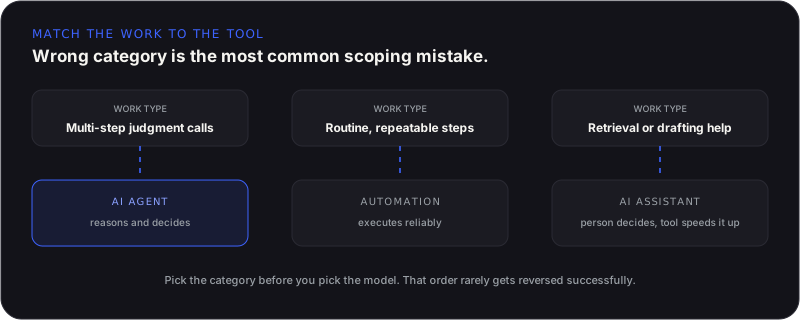
Gartner's own recommendation for avoiding cancellation is to match the technology to the type of work, rather than defaulting to "agent" because it is the term getting attention this year. Three categories cover most business work, and they call for three different tools.
- Use an AI agent when a task genuinely requires autonomous decisions across multiple steps, with judgment calls that would otherwise need a person weighing options in real time.
- Use automation when the workflow is routine and repeatable, the same steps every time, and does not need reasoning, only reliable execution.
- Use an AI assistant when the need is simple retrieval or drafting help, a person still makes the final call, and the tool speeds up the work rather than replacing the decision.
Businesses that skip this step tend to build an agent for something automation would have handled at a fraction of the cost, or they buy an assistant and expect agent-level autonomy from it. Either mismatch shows up later as an "AI project that failed," when the real failure happened at the scoping stage, months before a model was ever chosen.
Five Signals a Project Is Heading for Cancellation
These warning signs tend to show up months before a project actually gets pulled, which means there is usually time to correct course if someone is watching for them.
- No named owner: nobody can answer who is accountable if the agent makes a bad call this week, not in general, specifically this week.
- No baseline measurement: the team cannot say what the process cost or how long it took before the agent existed, so there is nothing to compare the result against.
- Scope keeps expanding: what started as one workflow has quietly grown to cover five, without anyone revisiting the original budget or timeline.
- Success is described in activity, not outcomes: reports lead with volume processed or messages sent instead of cost saved, errors avoided, or revenue protected.
- No plan for what happens when it is wrong: there is no fallback, no human review step, no way to catch and correct a mistake before it reaches a customer or a system of record.
How We Approach This at Agentiq Studios
When we scope an agentic AI engagement, the first conversation is not about which model to use. It is about which category of work we are actually looking at, agent, automation, or assistant, and what the baseline looks like before anything changes. That baseline is what turns "the agent seems to be helping" into a number a finance leader can defend, and it is the single biggest factor in whether a project survives its first budget review. From there, ownership and risk controls get built in from day one rather than bolted on after something breaks.
Related from Agentiq Studios: AI Strategy & Consulting (/services/ai-strategy-consulting), Agentic Processes (/solutions/agentic-processes).
Final Thoughts
A canceled AI agent project is not proof that agentic AI does not work. Gartner's own forecast has adoption climbing sharply through 2028 at the same time it predicts widespread cancellations this year and next. Both trends come from the same root cause: the technology is ready faster than most organizations' scoping discipline is. The businesses that avoid becoming part of the 40% are not the ones with the most advanced model. They are the ones that picked the right category of tool for the job, named an owner, measured a real baseline, and built in a way to catch mistakes before the project ever launched.