The AI Infrastructure Playbook
What you'll learn
- Where AI actually creates value
- How AI agents, automation, and RAG work together
- Why architecture matters more than the model
- How to build infrastructure that scales affordably
If you spend enough time on LinkedIn, it feels like every company is becoming an AI company. Every day there’s a new model, agent, framework, or startup claiming they’ve built the future. It’s exciting, and incredibly noisy.
After working with businesses across industries, we’ve noticed something: the companies getting the biggest results aren’t chasing every new model. They’re solving very ordinary business problems, reducing repetitive work, helping employees find information faster, improving support, automating operations, and making better decisions. This guide isn’t about the newest model. It’s about building AI that actually improves how a business operates.
TL;DR: AI infrastructure is automation, knowledge retrieval, and AI agents working together instead of three disconnected tools. Automation moves information, RAG retrieves it, agents reason about it. The businesses that win aren’t using the biggest models, they’re using the architecture that routes each task to the cheapest tool that reliably handles it, the same principle behind why the smartest AI setups are rarely the most expensive ones.
The Biggest Misunderstanding About AI
Many businesses begin with the wrong question, “How can we use AI?” Instead, they should ask, “What slows our business down every single day?” Technology changes every few months; business problems usually don’t. If your support team answers the same questions daily, if employees spend hours searching for documents, if reports take days to prepare, those are business problems. AI simply becomes one of the tools for solving them. BCG’s research on AI strategy backs this up directly: the businesses seeing real returns are the ones that redesign the workflow around the problem first, not the ones that bought the most tools.
Where AI Actually Creates Value
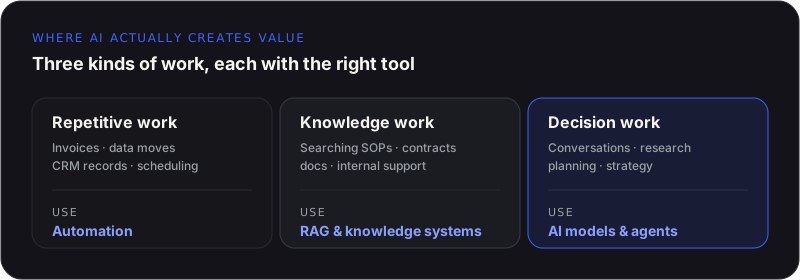
Not every workflow should use AI. We think about work in three categories. Repetitive work, tasks with clear rules like invoices, data movement, CRM records, scheduling, and approvals, where traditional automation is usually enough.
Knowledge work, tasks where people spend time finding information like searching SOPs, contracts, customer information, and documentation, where knowledge systems and RAG create tremendous value.
Decision work, tasks requiring reasoning like customer conversations, sales recommendations, research, planning, and strategy, where AI models and agents become valuable. Understanding these differences is often more important than choosing the latest model.
AI Agents, Automation and RAG
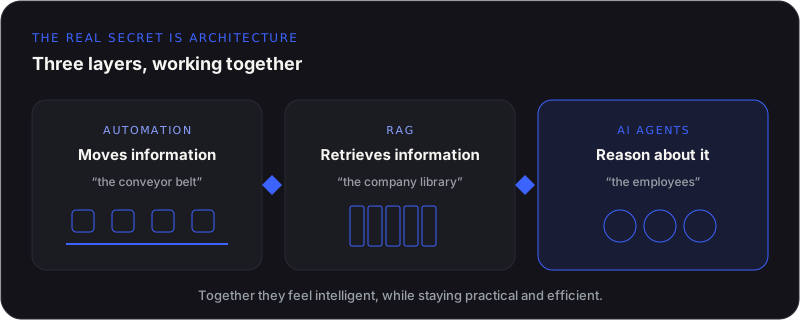
Businesses often think they need one solution. Most successful AI infrastructures combine all three. Automation moves information. RAG retrieves information. AI agents reason about information. Think of it this way: automation is the conveyor belt, RAG is the company library, and AI agents are the employees using that library to make decisions. If you are still deciding which of the three your next project actually needs, AI agents vs AI automation and what RAG is both go deeper on where each one fits.
The Real Secret Isn’t AI, It’s Architecture
Two companies can use the exact same AI model. One spends $500 per month, the other $15,000. The difference isn’t intelligence, it’s architecture. Good architecture decides which tasks actually require AI, which workflows stay automated, when to retrieve information, when to use reasoning, which model handles which task, and how everything connects. Architecture determines whether AI becomes an investment or an expense. We cover this specific trap in why most businesses overpay for AI, and our AI Architecture Design work exists specifically to get this decision right before anything gets built.
Local Models Are Changing the Economics
Modern open-weight models like DeepSeek, Kimi, Llama, Qwen, Mistral, and Gemma have made high-quality AI far more accessible. Many businesses can now deploy capable systems on their own infrastructure, reducing dependency on external APIs while improving privacy and lowering long-term costs. Not every workload belongs on a self-hosted model, but many do.
Your Company’s Biggest Asset Is Its Knowledge
Every business has valuable knowledge, policies, processes, training, customer history, documentation, meeting notes, internal expertise. The problem isn’t creating knowledge; it’s finding it. This is why enterprise knowledge systems have become one of the highest-impact AI investments. Knowledge becomes an asset that stays with the company, even when people leave. This is exactly what our RAG Development and RAG Deployments work is built to capture, and it is usually one of the first seven questions worth answering, per what to ask before you build AI.
AI Should Help People Do Better Work
The best AI projects don’t replace people, they replace repetitive work. Media buyers spend less time creating campaigns, support teams answer fewer repetitive questions, finance teams process fewer invoices manually, and executives receive reports automatically. People continue making decisions; AI removes the repetitive work surrounding them.
Where Businesses Are Heading
The next generation of businesses won’t be defined by how many AI tools they buy, but by how intelligently those tools work together, connected systems, shared knowledge, automated operations, specialized agents, and smarter decision-making. That’s what AI infrastructure looks like, and where the biggest competitive advantage will come from over the next decade.
Related from Agentiq Studios: AI Architecture Design, AI Strategy & Consulting, Ops Automation, and Agentic Processes.
A Starter Roadmap: What to Build First
If you are starting from zero, sequencing matters more than any individual tool choice. Most businesses that get this right follow a similar order, even though the specific systems differ.
- Start with knowledge, not agents. Get RAG working over your single most-asked-about knowledge source before building anything that reasons or acts on its own.
- Automate the obvious repetitive work next. If a process always follows the same steps, it does not need AI, it needs automation, and that is usually the fastest win on the board.
- Add reasoning only where uncertainty actually exists. This is where the line between AI agents and automation matters, agents cost more to run, so they belong on work that genuinely needs judgment.
- Add coordination last, once a single agent is proven. Multi-agent orchestration is a scaling decision, not a starting point.
Businesses that skip straight to the most advanced layer, agents coordinating other agents, before proving out retrieval and automation usually end up rebuilding from the bottom anyway. Build the foundation first. The advanced layer gets much easier once it exists.
Final Thoughts
The question isn’t whether AI will change how businesses operate, it already has. The real question is whether your AI becomes another disconnected tool, or part of the infrastructure that helps your business grow every day. Technology will keep evolving, but businesses that focus on thoughtful architecture, practical implementation, and long-term value will keep benefiting long after today’s trends have changed.