AI Agent Evaluation: How to Test Before You Deploy
What you'll learn
- Why a strong benchmark score and strong real-world performance are two different things, with a documented gap between them
- What an evaluation harness is and why the strongest teams write it before they build the second agent
- Why testing an agent once (pass^1) hides a reliability problem that testing it four times (pass^4) reveals
- What happened when a dedicated safety benchmark tested 16 production AI agents
- Why vendor-built agents tend to reach positive ROI faster than custom builds, and what that gap is actually measuring
- A practical checklist for evaluating an agent before it touches a real customer
Evaluating an AI agent before deployment means testing it against a fixed set of realistic tasks, including edge cases and adversarial inputs, in a sandboxed environment, and checking the result against a defined target state before a real customer ever sees it. Most businesses skip this and judge an agent by a demo instead, which is exactly why so many agents that look great in a sales call fail once they hit real workflows, real data, and real edge cases.
TL;DR: a good demo and a production-ready agent are not the same thing, and the gap between them is measurable. Research on enterprise agentic AI deployments has found roughly a 37% gap between lab benchmark scores and real-world performance, with cost variation as high as 50x between agents scoring similarly on paper. The fix is not a better model. It is building an evaluation harness, a fixed set of tasks plus an automated grader, before the agent goes live, and testing for consistency across repeated runs, not just a single successful pass.
Why the Benchmark Number Isn't the Real Number
A benchmark score tells you how an agent performed on a fixed set of questions in a controlled setting. It does not tell you how the agent behaves when a customer phrases a request oddly, when an upstream tool times out, or when the same question can be answered through two different, equally valid reasoning paths. Traditional software testing assumes a program returns the same output for the same input every time. Agents break that assumption by design: they reason through a problem and choose tools based on context, so the same request can take different valid routes to the same goal. A wrong tool choice at step two of a five-step workflow rarely shows up immediately. It cascades, and by the time it surfaces as a bad outcome, it can be hard to trace back to where it actually went wrong.
This is also why general-purpose benchmarks are losing usefulness at the top end. Every frontier large language model now scores above 88% on MMLU, a widely used general knowledge benchmark, which means the gap between models on that test has shrunk to statistical noise. Harder, more current tests tell a different story: Humanity's Last Exam holds the best AI models to roughly 35% accuracy, against a human expert average near 90%, a 50-plus point gap that older, saturated benchmarks never reveal. If your evaluation strategy leans on a general leaderboard score, you are measuring the wrong thing for the decision you actually need to make.
What an Evaluation Harness Actually Is
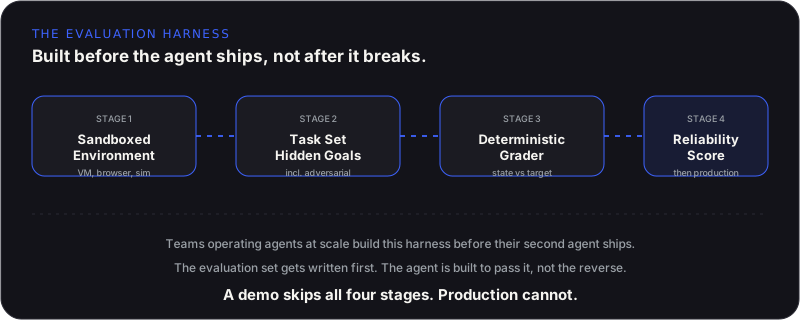
An evaluation harness is the infrastructure that lets you test an agent repeatedly and consistently instead of eyeballing a handful of transcripts. In 2026, a serious agent benchmark has three parts: a sandboxed environment, a Linux VM, a real browser, or a customer-service simulator, a list of goals with hidden ground-truth end states, and a deterministic grader that compares the agent's final state against that target. LangChain's 2026 research on agent engineering found that companies running agents at scale, including Lyft, Cisco, and Toyota, build a shared evaluation harness before their second agent ever ships. The strongest teams write the evaluation set first and build the agent to pass it, rather than building the agent first and figuring out how to test it afterward.
The Metric Most Teams Get Wrong: Pass^1 vs Pass^4
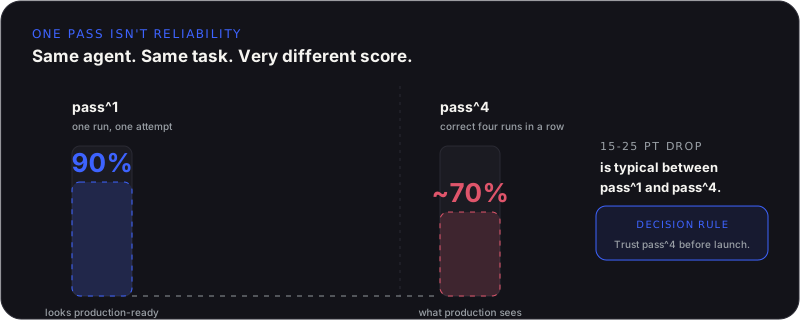
A single successful run tells you almost nothing about how an agent will behave in production, where it runs the same type of task hundreds of times a day. The pass^k methodology addresses this directly: pass^1 measures raw accuracy on one attempt, while pass^4 requires the agent to complete the same task correctly across four independent runs. The gap between the two is large and consistent. Pass^4 scores commonly run 15 to 25 points below pass^1, which means a 90% benchmark score on a single run can correspond to closer to 70% real reliability once you require consistency. A business that greenlights a deployment based on one clean demo run is looking at the wrong number entirely.
There is also a grading problem underneath many of these scores. Many benchmarks fall back on using another LLM to grade partial credit when a clean ground truth is hard to encode, and multiple 2025 and 2026 audits found error rates above 50% in LLM-graded judgments, driven by position bias, length bias, and a tendency to agree with whatever answer looks confident. In one documented test, simply swapping the position of two identical answers flipped the grader's verdict about 40% of the time. If your evaluation harness leans entirely on an LLM judge with no deterministic ground truth, the score it produces deserves real scrutiny before anyone trusts it.
What Happens When Nobody Tests for Safety
Capability testing and safety testing are different questions, and skipping the second one is common. Agent-SafetyBench, a dedicated safety evaluation benchmark, tested 16 production AI agents across 2,000 test cases spanning eight categories of safety risk, using 349 distinct interaction environments. None of the 16 agents scored above 60%. That is not a capability gap, it is a controls gap: agents that can complete the task can still take an unsafe or unintended path to get there, and most evaluation efforts never check for that specifically because it is easier to test whether an agent got the right answer than whether it got there safely.
- Task accuracy asks: did the agent reach the correct end state?
- Reliability (pass^k) asks: does it reach that state consistently across repeated runs?
- Safety testing asks: did it avoid unsafe actions, data exposure, or scope creep on the way there, including under adversarial or misuse-style prompts?
- Cost-to-serve asks: what did reaching that accuracy actually cost, since research shows up to 50x cost variation between agents with similar accuracy scores.
The upside of taking this seriously is real and measurable. One documented case saw an agent launch at a 20% containment rate, the share of interactions it resolved without human escalation, and reach 60% or higher after a focused sprint built entirely around structured evaluation, not a bigger model. Evaluation is not just risk management. It is one of the more reliable levers for improving an agent that is already live.
Why Vendor Agents Often Reach ROI Faster Than Custom Builds
This connects directly to a build-versus-buy pattern showing up in 2026 adoption data. Vendor-deployed agents have been reaching positive ROI faster than custom in-house builds, with time-to-first-value averaging 38 days for vendor platforms versus 94 days for custom builds, and the share of programs that never reach payback dropping from 34% in 2025 to 19% in 2026. That improvement is not primarily about the vendors having better models. It is largely because vendor platforms increasingly ship with evaluation harnesses and integration templates already built in, work that custom-build teams otherwise have to invent from scratch before they can trust their own agent enough to launch it.
This is the same lesson covered in our guide to build vs buy AI agents: the real cost of a custom build usually is not the model or the initial engineering. It is the evaluation, guardrail, and integration work a business has to build itself if it wants the same confidence a mature vendor platform already ships with.
A Practical Evaluation Checklist Before You Deploy
- Do you have a fixed set of realistic tasks, including edge cases and adversarial inputs, that the agent must pass before launch, not just a handful of happy-path demo runs?
- Does your grader compare the agent's final state against a defined target, rather than relying only on an LLM to eyeball whether the output looks right?
- Have you tested the same task multiple times (pass^k), not once, to see whether the agent is consistent or just got lucky on the run you watched?
- Has anyone specifically tested for unsafe or out-of-scope actions, not just wrong answers?
- Do you know the real cost per successful interaction, not just the accuracy score, since two agents at the same accuracy can cost very differently to run?
- Is there a plan to keep evaluating after launch, since real traffic will surface edge cases no pre-launch test set anticipated?
How We Approach This at Agentiq Studios
When we build or deploy an agent for a client, the evaluation harness gets built alongside the agent, not after something breaks. That means defining the task set and the target end states before development finishes, testing for consistency across repeated runs rather than trusting a single clean demo, and checking for unsafe paths specifically rather than assuming a high accuracy score covers it. It costs more time up front than shipping on a good demo. It costs far less than finding the gap after a customer does.
Related from Agentiq Studios: AI Deployment & DevOps (/services/ai-deployment-devops), Agentic Processes (/solutions/agentic-processes).
Final Thoughts
A confident demo and a production-ready agent are separated by a gap that is well documented and measurable, not a gap of luck. The businesses that avoid getting burned by that gap are not the ones with access to the newest model. They are the ones that built an evaluation harness before launch, tested consistency across repeated runs instead of trusting one pass, and checked for safety specifically instead of assuming a high accuracy score meant the agent was ready. Do that work before deployment, and the agent that reaches your customers is the one you actually tested, not the one that happened to look good in a demo.