AI Agent Memory: Why Your Agents Keep Forgetting
What you'll learn
- The difference between memory and context, and why teams confuse them
- The three memory types that actually matter for a business agent: episodic, semantic, and procedural
- What it costs a business when an agent has no memory at all
- How memory pipelines actually work: extraction, storage, retrieval, injection
- Why unmanaged memory quietly becomes a cost and privacy problem
- Where to start without building a memory system nobody needs yet
AI agent memory is the system that lets an agent recall facts, decisions, and prior interactions across sessions instead of starting from a blank slate every single time. Without it, an agent is a brilliant stranger: capable in the moment, but it has never met your customer before, does not remember what was already tried, and will happily repeat a question your team answered yesterday.
TL;DR: memory and context are not the same thing. Context is what the model sees on this one call. Memory is the durable record the agent draws on to build that context in the first place. Most businesses that complain their AI agent "feels dumb" or "keeps repeating itself" do not have a model problem, they have no memory layer at all, or one that stores everything and retrieves nothing useful. The fix is architectural: decide what actually needs to persist, store it as structured facts instead of raw transcripts, and retrieve only what is relevant to the current task.
Memory Is Not Context. It Feeds Context.
It is easy to conflate the two because they show up together in the same context window. But they solve different problems. We cover the broader discipline of assembling everything a model sees in context engineering for AI agents, and memory is one specific input into that assembly, not the whole thing.
- Context is temporary. It is what gets assembled for one call and discarded after.
- Memory is durable. It is what gets written down after an interaction so a future call can use it.
- Context answers "what does the model need right now?" Memory answers "what should the agent still know tomorrow?"
- A context window with no memory feeding it can still be well engineered and the agent will still forget everything the moment the session ends.
What It Actually Costs a Business to Skip Memory
Without memory, every conversation restarts cold. A returning customer has to re-explain their issue because the support agent has no record it was already raised last week. A sales agent asks a prospect the same qualifying questions on the second call that it asked on the first. A research agent re-reads the same source documents it already summarized yesterday, because nothing about that summary survived past the session. None of this is a reasoning failure. The model is working correctly. It simply has nothing to work from.
The business cost shows up in two places: a worse experience for the person on the other end, who notices immediately when they have to repeat themselves, and wasted spend re-deriving the same conclusions the agent already reached once. Both are avoidable with the same fix.
The Three Memory Types That Actually Matter
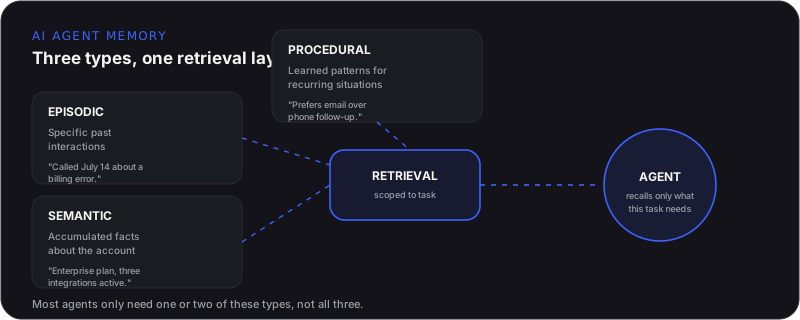
Most production memory systems converge on the same three categories, borrowed from how memory is described in cognitive science and adapted for agents. You do not need all three for every agent. You need to know which ones your use case actually requires.
- Episodic memory: what happened in a specific past interaction. "The customer called on July 14th about a billing error and was told a refund was processing." This is what makes an agent feel like it remembers you.
- Semantic memory: accumulated facts about a person, account, or business, independent of any single conversation. "This customer is on the enterprise plan and has three integrations active." This is what makes personalization possible without re-asking basic questions.
- Procedural memory: patterns for how to handle recurring situations, learned from past outcomes. "This customer prefers email over phone follow-up." This is what makes an agent get better at handling a given account over time instead of treating every interaction identically.
How a Memory Pipeline Actually Works
Underneath the taxonomy, a working memory system is a four-step loop, and most of the engineering effort lives in the first and last steps, not the storage itself.
- Extraction: after an interaction, the system pulls out facts worth keeping, not the raw transcript. "Customer prefers Tuesdays for calls" survives. The full back-and-forth that led to that fact usually does not need to.
- Storage: extracted facts get written to a database, typically a vector store for semantic search plus a structured store for facts that need exact lookup, indexed by user, account, or agent so retrieval can be scoped later.
- Retrieval: at the start of a new session or task, the system searches stored memory for what is relevant to the current request, using semantic similarity, keyword matching, or both, not just pulling the most recent entries.
- Injection: the retrieved memories get added into context for this call, competing for space with everything else the agent needs to see, which is exactly where memory and context engineering meet.
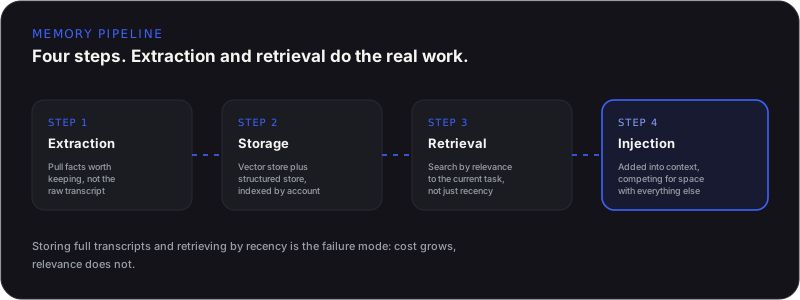
The extraction step is where most naive implementations fail. Storing entire transcripts and retrieving by recency feels simple to build, but it means every stored session grows the memory store linearly and every retrieval either pulls too much irrelevant history or misses the one fact that mattered. We saw exactly this failure mode play out as a cost problem in our guide to AI agent cost optimization: unmanaged memory injection scales token cost with how much history exists, not with how much of it is actually useful, so a system that never prunes or summarizes gets more expensive every week without getting any smarter.
Memory Is Also a Privacy and Governance Question
A memory store is a permanent record of what an agent learned about a person or a business, which means it inherits every data-handling obligation your business already has around that information. Before building one, three questions need real answers, not assumptions.
- Retention: how long does a memory entry live, and who decided that window? "Forever" is rarely the right default.
- Correction and deletion: if a stored fact is wrong or a customer asks for their data removed, can the system actually find and delete it, or is it buried inside an opaque vector store?
- Scope: is memory isolated per customer, per account, or per agent, or can one user's stored history leak into another user's retrieval by accident?
None of these are exotic requirements. They are the same data governance discipline any customer database already needs, applied to a new kind of store that is easy to bolt on without thinking about it the same way.
Where to Start Without Overbuilding
Not every agent needs a full episodic, semantic, and procedural memory system on day one. A one-off internal tool that answers a single question and closes the session might not need memory at all. A customer-facing agent handling repeat interactions almost certainly does, starting with semantic memory, the durable facts about the account, before adding episodic recall of specific past conversations. Build the retrieval and pruning logic in from the start rather than storing everything and hoping to sort it out later. That is the same lesson from context engineering: a context pipeline that dumps in everything available is not more thorough, it is just more expensive and less accurate.
How We Approach This at Agentiq Studios
When we design memory into an agent, the first question is which of the three types the use case actually needs, not whether to add "memory" as a checkbox feature. A support agent usually needs semantic memory of the account and episodic memory of recent tickets. A research agent building on prior work over weeks needs a different shape entirely. We scope extraction and retrieval to that specific need, build in retention and deletion from the start, and treat memory as part of the same context budget we manage for RAG and tool outputs, not a separate system bolted on afterward. This work sits alongside our AI Agent Development and AI Architecture Design services, and often runs through a custom MCP server so memory retrieval is one governed, auditable connection rather than a direct database link scattered across every agent that needs it.
Related from Agentiq Studios: AI Agent Development (/services/ai-agent-development), RAG Development (/services/rag-development), Agentic Processes (/solutions/agentic-processes).
Final Thoughts
An agent without memory is not broken, it is just incomplete. It can reason well within a single session and still feel useless the moment that session ends, because nothing it learned survives to the next one. The businesses getting real value out of agent memory are not the ones storing the most. They are the ones storing the least they can get away with: the specific facts that make the next interaction faster, more accurate, or more personal, retrieved on purpose instead of dumped in by default.