Before You Build AI: 7 Questions Every Business Should Answer
What you'll learn
- Whether your business is ready for AI
- Which workflows should be automated first
- Common implementation mistakes
- How to build AI that delivers measurable value
Over the last year, we’ve spoken with founders, CEOs, operations leaders, and product teams who all wanted the same thing: “We want to implement AI.” The interesting part? Very few knew where AI would create the biggest impact. That’s completely normal, AI is evolving incredibly fast. It’s easy to think the first step is choosing the right technology. It isn’t. The first step is asking the right questions.
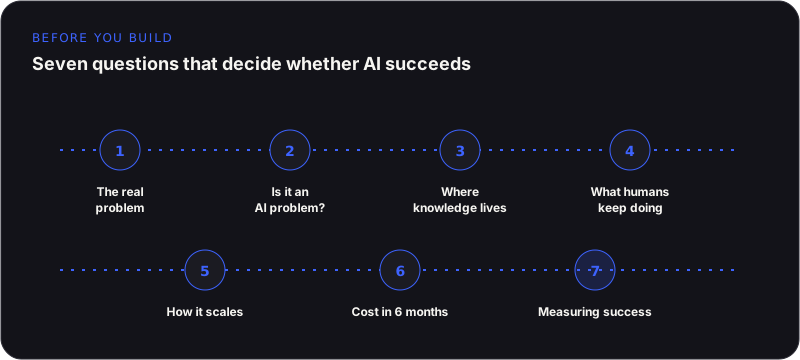
TL;DR: the seven questions are what problem you are actually solving, whether it is really an AI problem, where your business knowledge lives, what humans should keep doing, how the system scales, what it costs six months from now, and how you will measure success. Answer these before picking a model or a vendor, not after.
1. What Problem Are You Actually Trying to Solve?
Businesses often begin with “We need an AI chatbot” instead of “Why do we think we need one?” Maybe the real problem isn’t support, maybe customers can’t find information, teams spend hours searching documents, approvals take too long, or reporting is manual. AI isn’t the goal. Solving business problems is. Start there.
2. Is This Actually an AI Problem?
Not every problem needs AI. If a workflow always follows the same steps, automation is usually enough. If a system needs to understand language, make recommendations, search knowledge, or reason through complex situations, that’s where AI becomes valuable. Knowing the difference can save thousands in implementation and operating costs.
3. Where Does Your Business Knowledge Live?
Every company has valuable knowledge, but it’s usually scattered across documents, emails, Drive, Notion, Slack, CRMs, shared folders, old project files, and the heads of experienced employees. Before building AI, identify where your knowledge lives, because one of the highest-value AI investments isn’t generating content, it’s making existing knowledge instantly accessible. That is the exact problem RAG is built to solve, and it is usually the first thing worth mapping before any other AI decision.
4. What Should Humans Continue Doing?
AI is exceptional at repetitive work. People are exceptional at judgment, creativity, relationships, and strategic thinking. The best AI systems don’t replace teams, they remove repetitive work so people focus on higher-value decisions. Ask what work people should stop doing; that’s usually where AI belongs.
5. How Will This Scale?
An AI demo isn’t the same as an AI business. It’s easy to build something that works for ten users, much harder for ten thousand. Before choosing a model, think about the future: more departments, more customers, more integrations, and how costs change as usage grows. Planning for scale early prevents expensive rebuilds later.
6. What Will This Cost Six Months From Now?
Most businesses estimate development costs but forget operating costs. Every API request, response, workflow, and model accumulates over time. Could a smaller model achieve the same result? Would a local model make more sense? Could RAG reduce unnecessary usage? Could automation replace part of the workflow? These decisions matter more than most people realize.
7. How Will You Measure Success?
Success isn’t “we launched an AI assistant.” Success is reduced response times, eliminated manual work, faster onboarding, better reporting, lower operating costs, and increased productivity. Define success before development begins, otherwise it’s difficult to know whether the investment delivered real value.
A Better Way to Think About AI
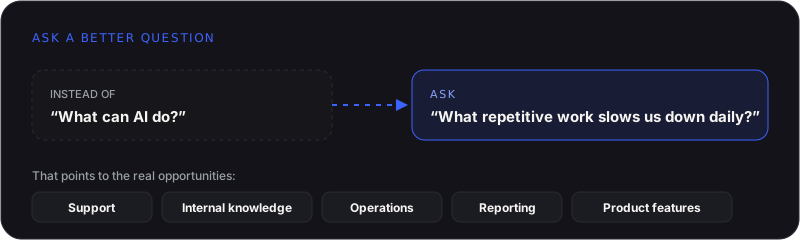
Instead of asking “What can AI do?” ask “What repetitive work slows our business down every day?” That’s where the best opportunities usually exist, support, internal knowledge, operations, reporting, or product features. AI is simply another tool; the value comes from applying it to the right problem. This is the same discovery process we run in our AI Strategy & Consulting engagements, and it is also where an AI Infrastructure Audit earns its cost, by surfacing exactly where the repetitive work actually lives before anyone commits to building anything.
Related from Agentiq Studios: AI Strategy & Consulting and AI Infrastructure Audit.
What Skipping These Questions Actually Costs
The pattern we see most often isn’t a bad idea, it’s a good idea built in the wrong order. A team picks a model, builds a demo, gets excited, and only then asks what it should have asked in week one: where does the knowledge actually live, what happens when this scales past ten users, and what will this cost once real traffic hits it. By then the architecture is already set, and changing it means rebuilding, not tuning. BCG’s research on AI impact makes the same point at the company level: without a clear value logic defined up front, a meaningful share of the expected value erodes before it ever reaches the P&L.
- Question 3 (where does your knowledge live) skipped: teams build a chatbot before realizing the answers it needs are scattered across six systems nobody mapped first
- Question 5 (how will this scale) skipped: a demo that worked beautifully for five people falls over at fifty, because nobody priced out the difference
- Question 6 (what will this cost in six months) skipped: a bill that looked reasonable in the pilot triples once real usage hits it, with no plan to bring it back down
None of these are exotic failures. They are the direct, predictable result of answering “what can AI do” before answering “what does our business actually need.” The seven questions above exist specifically to catch these before they get expensive.
Final Thoughts
The companies getting the most value from AI aren’t necessarily using the newest models, they’re asking better questions before building anything. Understand your business first, and choosing the right technology becomes much easier. Combined with thoughtful architecture, AI becomes more than a feature; it becomes infrastructure that helps your business grow for years.