RAG vs Fine-Tuning: Which Is Right for Your Business?
What you'll learn
- The real difference between RAG and fine-tuning
- When each approach is the right choice
- How the two compare on cost and maintenance
- Why most businesses should start with RAG
- When combining both makes sense
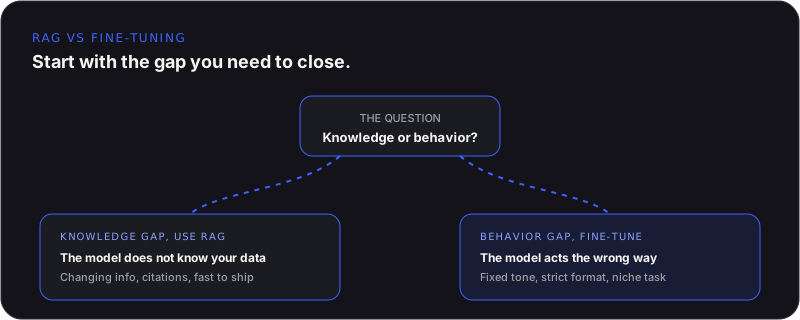
If you are choosing between RAG and fine-tuning, here is the short version. Use RAG when the problem is that AI does not know your information. Use fine-tuning when the problem is that AI does not behave the way you need. Most businesses should start with RAG, and many end up combining both.
TL;DR: RAG solves a knowledge gap by retrieving your information at answer time. Fine-tuning solves a behavior gap by retraining the model on examples. RAG is cheaper and faster to launch and stays current automatically; fine-tuning costs more upfront but can lower cost per answer at very high, stable volume. Start with RAG unless you already know your gap is tone, format, or a specialized skill.
Both are ways to make a general AI model useful for your specific business, but they solve different problems. Confusing the two is one of the most common, and most expensive, mistakes we see teams make.
What Each One Actually Does
RAG, short for Retrieval-Augmented Generation, connects a model to your own information. The moment someone asks a question, the system searches your documents, finds the relevant parts, and hands them to the model so it can answer from your knowledge instead of guessing. If you want the plain-language version first, read our guide on what RAG is.
Fine-tuning works differently. Instead of giving the model information at answer time, you retrain it on many examples so its behavior changes. Fine-tuning is how you teach a model a consistent tone, a strict output format, or a specialized task it does not handle well out of the box.
The Core Difference: Knowledge vs Behavior
Here is the simplest way to decide. Ask what is actually missing. If the model would answer correctly if only it knew your facts, that is a knowledge gap, and RAG solves it. If the model knows enough but answers in the wrong style, format, or structure, that is a behavior gap, and fine-tuning solves it.
| Dimension | RAG | Fine-Tuning |
|---|---|---|
| What it fixes | A knowledge gap: the model does not know your facts | A behavior gap: the model knows enough but acts or sounds wrong |
| Best for | Docs, policies, and data that change often | Consistent tone, a strict format, or a specialized skill |
| Time to a working system | Often weeks | Longer, a training run is required |
| Upfront cost | Lower, no training run | Higher, training is the upfront cost |
| Keeps answers current | Yes, update the source and refresh the index | No, requires retraining when facts change |
| Provides citations | Yes, answers point back to source documents | No, behavior changes but sourcing does not |
| When combined | Supplies live facts on top of a tuned model | Shapes how the model reasons and speaks |
When to Use RAG
RAG is the right choice for most business use cases, especially anything built on your own documents and data.
- Your knowledge changes often, so answers must stay current
- You need citations and sources people can trust
- The information lives in your docs, policies, SOPs, or support tickets
- You want a working system in weeks, not months
- You are building support, internal search, or document Q&A
RAG also tends to be more accurate for knowledge-heavy tasks. When the answer exists in a document, retrieval finds it. And when your data changes, you simply update the source and refresh the index, with no retraining required.
When to Use Fine-Tuning
Fine-tuning is the right call when the gap is behavior, not knowledge.
- You need a consistent brand voice across every response
- You require a strict output format that prompting cannot reliably enforce
- You have a specialized task the base model handles poorly
- You have a large, stable set of high-quality examples to learn from
- Response speed matters and a smaller tuned model can replace a larger one
Fine-tuning assumes fairly stable knowledge. If your information changes weekly, retraining a model every time it changes becomes slow and expensive. Our Fine-Tuning & Model Optimization work usually starts by confirming the gap is actually behavior, not knowledge, before committing to a training run.
What About Cost?
Cost depends less on the technique and more on your scale, but the shape of the spending is different for each.
- RAG usually has a lower upfront cost because there is no training run, with most spend going to retrieval, storage, and ongoing operation
- Fine-tuning has a higher upfront cost to train the model, but can lower per-answer cost later if a smaller tuned model replaces a larger one
- RAG needs ongoing upkeep of the knowledge base and index; fine-tuning needs a retrain whenever the knowledge itself changes
For most businesses at moderate volume, RAG reaches a production-quality system faster and at a lower total cost. The economics shift toward fine-tuning mainly at very high, stable query volumes. This is exactly the kind of trade-off we weigh in our cost-optimized approach, because the wrong choice quietly inflates your bill for years.
The Hybrid Approach (Often the Real Answer)
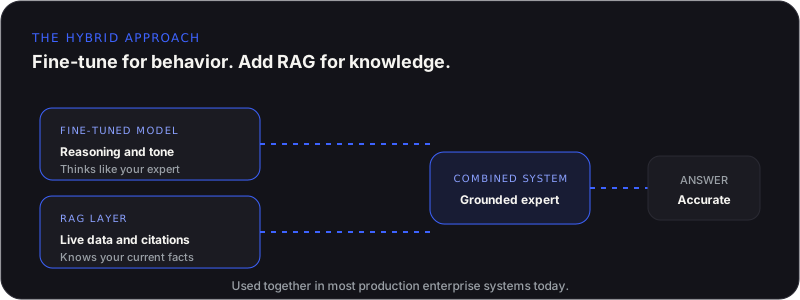
For more advanced systems, the honest answer is often both. You fine-tune a model so it reasons and speaks like your domain expert, and you add RAG so it always has your current facts and can cite them. Fine-tuning shapes how it thinks; RAG keeps what it knows up to date. AWS’s own guidance on the two approaches reaches the same conclusion: the two aren’t mutually exclusive, and combining them is a legitimate production pattern, not a compromise.
A legal assistant is a good example. The model can be tuned to understand and write in a legal style, while RAG pulls the latest case law and regulations at answer time. Neither approach alone would be enough.
How to Decide: A Short Checklist
- Does the answer already exist in your documents? If yes, lean RAG
- Does your information change often? If yes, lean RAG
- Do you need sources and citations? If yes, lean RAG
- Do you need a fixed tone or strict format? If yes, consider fine-tuning
- Do you have thousands of stable, high-quality examples? If yes, fine-tuning becomes viable
- Is this a high-volume task where a smaller tuned model saves money at scale? If yes, consider fine-tuning
Our Recommendation: Start With RAG
When a business is unsure, we almost always recommend starting with RAG. It is cheaper to build, faster to launch, and it gives you real usage data within weeks. That data, the actual questions people ask and where answers fall short, tells you precisely what, if anything, is worth fine-tuning later. You end up spending on fine-tuning only when you have proof it will pay off.
Related from Agentiq Studios: RAG Development and RAG Deployments. For the plain-language basics, see What Is RAG.
RAG and fine-tuning are not rivals. They solve different problems, and the right architecture depends on whether your gap is knowledge or behavior. Get that decision right and you build AI that is accurate, current, and affordable to run.