AI Agent Cost Optimization: Where the Budget Really Goes
What you'll learn
- Why rising AI agent bills are an architecture problem, not a model pricing problem, and where the largest hidden costs actually sit
- How poor context management alone accounts for 60 to 70% of total AI agent spend, and how a single task can balloon past 125,000 input tokens
- Why naive memory injection scales token cost linearly with every stored entry, and what that looks like a few weeks into production
- What model routing is, and why cascading requests across cheap and premium models is the highest-leverage cost fix available in 2026
- A real example of an agent loop that ran for 11 days and generated a $47,000 bill, and what would have stopped it
- A practical checklist for building cost governance into an agent before launch, not after the invoice arrives
AI agent cost optimization means controlling three things: how much context gets sent to the model on every call, which model handles each step of a task, and how many times an agent is allowed to retry before a spend limit or a human steps in. Most businesses treat a rising AI agent bill as a model pricing problem and respond by shopping for a cheaper model. That rarely fixes it, because the architecture around the model, not the model itself, decides most of the bill.
TL;DR: production AI agent model spend roughly doubled from $3.5 billion to $8.4 billion between late 2024 and mid-2025, and enterprises running agents now average more than $85,000 a month in AI operational costs. Production cost research keeps pointing at the same root cause: poor context management drives 60 to 70% of total agent spend, not the price of the model itself. The highest-leverage fixes are architectural: route each request to the right model for the job, keep context lean instead of replaying full history on every call, and put a hard ceiling on what a single agent run can spend before it ever reaches production.
Why the Model Bill Isn't the Real Bill
A single chatbot reply is one API call. An agent completing a task is rarely one call at all. It breaks the request into smaller steps, evaluates whether each result is good enough, and often reruns or revises a step before moving on, and every one of those steps can carry forward prior tool outputs and reasoning as additional context. A task that looks simple from the outside, summarize this document, find this record, update this field, can quietly trigger a dozen or more model calls before it finishes. This is also why the category is growing so fast: the global AI agents market reached roughly $10.91 billion in 2026, 51% of enterprises now run agents in production, and Gartner projects spending on agentic AI will hit $201.9 billion in 2026, up 141% from 2025. Volume like that means an inefficient architecture doesn't stay a small problem for long.
Where the Money Actually Goes: Context Bloat
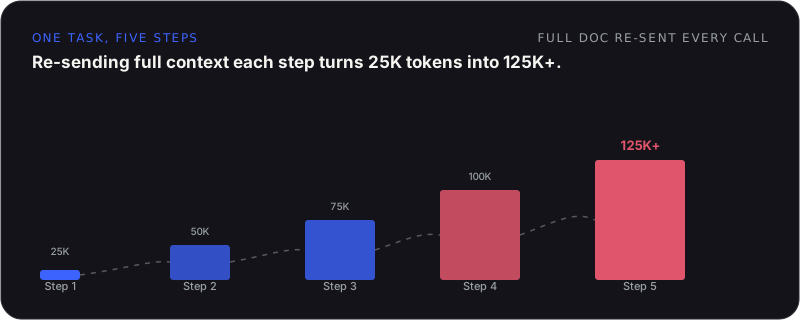
Poor context management is the single biggest cost driver in production agent traces, commonly accounting for 60 to 70% of total spend. The mechanism is straightforward and easy to miss until you look at the token counts directly. Take a research agent summarizing a 50-page PDF, roughly 25,000 tokens. If the agent takes five steps to refine its answer and naively reloads the full document at every step instead of working from a summary, that single task can consume more than 125,000 input tokens, five times the size of the source document, just from re-sending the same content over and over.
Memory injection has the same problem in a different shape. Pulling relevant history into a prompt scales roughly linearly with how much history exists: 24 stored memory entries might cost around 594 tokens per call, but 500 entries can cost close to 8,000 tokens per call for the exact same type of request. Production traces commonly show agent contexts growing to 80,000 to 120,000 tokens within two to three weeks of launch, not because the task got harder, but because nothing was trimming what got carried forward.
The Runaway Loop Nobody Budgeted For
Context bloat is a slow leak. A runaway loop is a burst pipe. Without loop detection or a hard spend ceiling, a misconfigured agent can keep calling itself and racking up charges long after any human is watching. One widely reported case involved a multi-agent system that ran an infinite loop for 11 days and generated $47,000 in API charges before anyone caught it. At a larger scale, one enterprise reportedly exhausted its entire 2026 AI budget by April, four months in, with $3.4 billion in planned spend gone. Neither of these is a model pricing problem. Both are governance problems: nothing was in place to stop a run that had clearly gone wrong.
Model Routing: The Highest-Leverage Fix
Model routing means dynamically choosing which model handles a given request based on how complex that request actually is, instead of sending every request, including a one-line lookup, to the most expensive model available. It has become standard practice by 2026 because the payoff is large and the price gaps between models are only widening: a frontier model can run around $10 per million input tokens while a fast, lightweight model from the same generation can run closer to $0.10 per million, roughly a 100x difference for tasks that don't need the expensive model's reasoning depth.
- Naive routing: every request, simple or complex, is sent straight to the flagship model. Cost scales linearly with volume, regardless of how easy the task actually is.
- Routed architecture: a lightweight classifier or a cheap first pass screens each request before anything expensive runs.
- Routed architecture: only requests that fail the cheap pass, or are flagged as genuinely complex, escalate to a premium model.
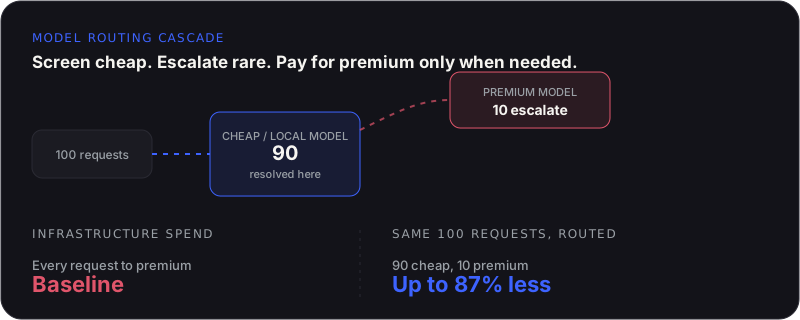
- Result: organizations using systematic routing report 30 to 70% cost reductions, and a well-tuned cascade that sends roughly 90% of requests to a cheaper tier while reserving the premium model for the hard 10% has reached as high as 87% reduction in infrastructure spend.
Beyond Routing: Fixing the Access Pattern Itself
Sometimes the fix isn't which model answers the request, it's how much interface an agent has to read before it can act at all. In February 2026, Cloudflare's Code Mode architecture collapsed more than 2,500 API endpoints into two callable tools consuming roughly 1,000 tokens of context, down from an estimated 1.17 million tokens for a traditional setup that exposed every endpoint as its own separate tool definition. That is the same lesson as context bloat, applied to tool access instead of conversation history: well-architected agents read specific line ranges or byte-range chunks instead of downloading a whole file, and search by metadata to filter results before spending any tokens on the actual content. We cover the mechanics of tool exposure in more depth in our guide to what an MCP server is, which is where a lot of this token overhead quietly accumulates.
Building Cost Governance Before the Invoice Arrives
- Does every agent have a per-run token or dollar ceiling that halts execution automatically, not just an alert someone might read later?
- Is there loop detection that kills a run after a fixed number of repeated identical tool calls, rather than after 11 days?
- Do you route by task complexity, or does every request, easy or hard, hit the same premium model by default?
- Is context trimmed or summarized between steps, or does every call replay the full history from step one?
- Do you track cost per successful task, not just total monthly spend, so you can tell whether a change actually helped?
- Is spend reviewed on a regular cadence as part of engineering work, or only discovered at the end of the billing cycle?
How We Approach This at Agentiq Studios
When we build or maintain an agent for a client, cost controls get designed in during the first architecture review, not bolted on after a surprise invoice. That means deciding upfront which steps genuinely need a premium model and which don't, keeping context windows lean instead of replaying full history by default, and setting spend ceilings and loop detection before the agent ever touches production traffic. It is the same discipline covered in our guide to measuring AI agent ROI: you cannot manage a number you are not tracking, and cost per successful task is exactly that kind of number.
Related from Agentiq Studios: AI Maintenance & Optimization (/services/ai-maintenance-optimization), Agentic Processes (/solutions/agentic-processes).
Final Thoughts
AI agent cost optimization is not primarily about which model you use. It is about how much context you send, how consistently you route work to the right tier of model, and whether anything stops a run that has gone wrong before it runs for days. The businesses seeing 60 to 80% reductions in token spend are not the ones that found a cheaper model. They are the ones that treated cost as an architecture decision from the start, instrumented it, and kept reviewing it after launch instead of only noticing when the bill did something unexpected.