Context Engineering for AI Agents: A Practical Guide
What you'll learn
- What context engineering actually means, and how it differs from prompt engineering
- Why base model quality stopped being the main lever for agent reliability
- The five inputs that make up a context window, and where each one comes from
- The five quality criteria a context pipeline needs: relevance, sufficiency, isolation, economy, provenance
- The most common failure modes: bloated context, stale context, and irrelevant context
- How to start building context engineering into an agent instead of bolting it on after launch
Context engineering is the discipline of deciding what information actually reaches an AI model on a given call: which instructions, which retrieved documents, which tool outputs, which prior turns, and in what order. It is the layer above prompt writing. A prompt is one message. Context is everything the model sees when it processes that message, and in 2026 it has become the biggest single factor in whether an AI agent performs reliably in production or falls apart under real workloads.
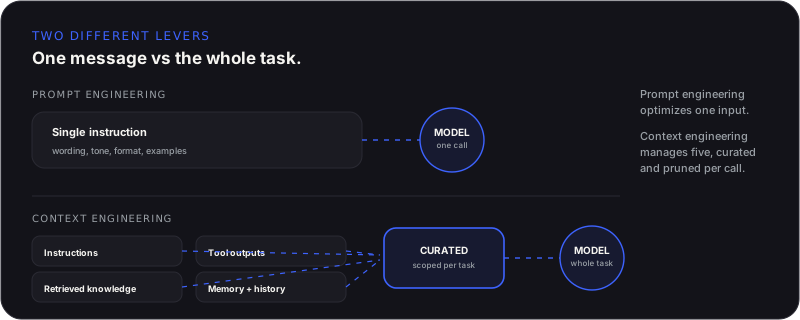
TL;DR: prompt engineering optimizes the words in a single instruction. Context engineering optimizes the entire information environment an agent operates in across a task: system instructions, retrieved knowledge, tool results, memory, and conversation history. As base models have gotten better at following instructions, the gap between a working agent and a failing one has shifted away from clever prompting and toward whether the agent is being fed the right information at the right time, in the right amount. Get context wrong and a capable model still makes bad decisions, because it is reasoning over incomplete, stale, or bloated information.
Why Context Engineering Replaced Prompt Engineering
Two years ago, the fastest way to improve an AI output was to rewrite the prompt: add examples, adjust tone, specify format. That lever still matters, but it has shrunk. Anthropic's own engineering team frames context engineering as the natural progression of prompt engineering, describing it as the set of strategies for curating and maintaining the optimal set of tokens during inference, including everything that lands in the context window beyond the prompt itself. Models got good enough at following instructions that the instructions stopped being the bottleneck. What they are reasoning over became the bottleneck instead.
That shift shows up clearly in enterprise deployment data. Gartner forecasts that 40% of enterprise applications will embed task-specific agents by the end of 2026. But Gartner has also predicted that over 40% of agentic AI projects will be canceled by the end of 2027, citing escalating costs, unclear business value, and inadequate risk controls. Notably, model capability is not on that list of failure causes. Poor context management is a recurring thread underneath it: agents fed fragmented data, deployed on broken workflows, operating without the institutional knowledge they need to act well.
What Is Actually Inside a Context Window
A context window is not just "the prompt." On any real agent call, it is an assembled stack of distinct inputs, and context engineering is the practice of deciding what goes into that stack, in what order, and how much of it survives.
- System instructions: the standing rules for how the agent should behave, scoped narrowly enough to stay followable
- Retrieved knowledge: documents, records, or passages pulled in for this specific task, typically through RAG
- Tool outputs: results from function calls, database queries, or API responses the agent made during the task, often via an MCP server
- Memory: relevant facts carried over from prior sessions or earlier in a long-running task, distinct from the live conversation
- Conversation history: the actual back-and-forth so far, which grows with every turn and needs active pruning, not indefinite accumulation
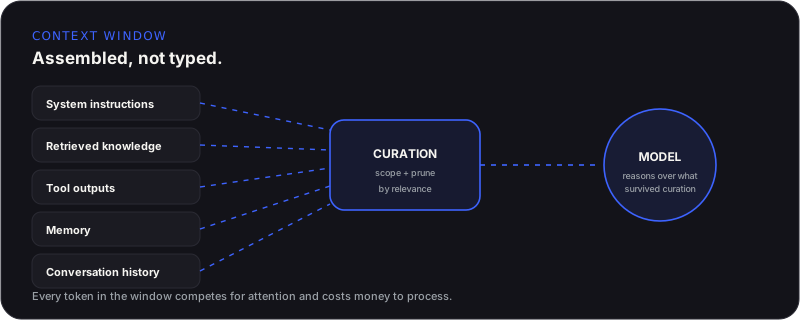
The mistake most teams make is treating all five of these as free. They are not. Every token in the context window competes for the model's attention and costs money to process. A context pipeline that dumps in an entire knowledge base "just in case" is not being thorough, it is diluting the signal the model needs to act correctly, and paying for the privilege.
Prompt Engineering vs Context Engineering vs RAG
These three get used interchangeably, and that confusion is part of why context problems get misdiagnosed as prompt problems. Each one solves something different.
- Prompt engineering: how you phrase a single instruction to get a better response from a given context
- RAG: one specific technique for pulling relevant external knowledge into context at run time, covered in depth in our RAG guide
- Context engineering: the umbrella discipline that decides what combination of instructions, retrieved knowledge, tool outputs, memory, and history the model sees at all, and manages the tradeoffs between them across an entire task, not a single call
A business can have a well-written prompt and a working RAG pipeline and still have a context engineering problem, because nobody is managing what happens when retrieved documents, tool results, and ten turns of conversation history all compete for the same limited window at once.
Five Quality Criteria for a Context Pipeline
A March 2026 academic paper on context engineering, Context Engineering: From Prompts to Corporate Multi-Agent Architecture, proposes five formal quality criteria for evaluating what goes into an agent's context. They are a useful checklist for any team building agent infrastructure, not just researchers.
- Relevance: does this piece of context actually bear on the current task, or is it along for the ride
- Sufficiency: is there enough context to complete the task correctly, without gaps that force the model to guess
- Isolation: is context scoped to what this specific agent or step needs, rather than shared indiscriminately across a multi-agent system
- Economy: is the context window kept lean enough that signal is not drowned out by volume, and token cost stays proportional to task value
- Provenance: can you trace where a piece of context came from, so a wrong answer can be debugged back to its source instead of treated as a black box
Most agents that behave unpredictably in production fail on one or two of these, not all five. A support agent hallucinating pricing usually has a sufficiency problem, missing the one document that had the actual number. A multi-agent workflow leaking irrelevant context between steps usually has an isolation problem. Diagnosing which one is broken is faster than rewriting the whole pipeline.
Common Context Engineering Failure Modes
Three patterns show up repeatedly in agents that were built fast and then started misbehaving at scale.
- Bloated context: every available document, every past turn, every tool result gets included by default, and the model starts missing details buried in the noise, even though technically nothing relevant was excluded
- Stale context: retrieved knowledge or memory reflects an earlier state of the business, a pricing page from three months ago, a policy that has since changed, and the agent confidently acts on information that is no longer true
- Irrelevant context: information gets pulled in because it was easy to fetch, not because it was needed, a common outcome of RAG pipelines tuned for recall over precision
Each of these is a design failure, not a model failure, which is exactly why better prompting does not fix them. Rewriting the instruction does nothing if the retrieved document was three months stale or the relevant fact was buried under forty irrelevant ones.
Where to Start
Context engineering does not require rebuilding an agent from scratch. It starts with an audit of what is currently flowing into the context window on a real task, and a blunt assessment against the five criteria above. In practice that means tracing one representative agent run end to end: what instructions fired, what got retrieved, what tools were called, what history carried forward, and how much of it actually mattered to the final answer. Most teams are surprised by how much of their context budget is dead weight.
From there, the fixes are usually structural rather than exotic: scope retrieval more tightly instead of widening it, prune conversation history on a schedule instead of letting it grow unbounded, separate context between agents in a multi-agent system instead of sharing one pool, and tag context with its source so a wrong output can be traced back to where the bad information entered.
How We Approach This at Agentiq Studios
When we design agent architecture for a client, context engineering is part of the initial build, not a fix applied after the agent starts misbehaving. That means scoping what each agent or step actually needs before wiring up retrieval, building memory and history pruning into the architecture rather than letting context accumulate by default, and tagging retrieved knowledge with its source so failures are traceable.
Related from Agentiq Studios: AI Architecture Design (/services/ai-architecture-design), RAG Development (/services/rag-development), Agentic Processes (/solutions/agentic-processes).
Final Thoughts
The businesses getting reliable results from AI agents in 2026 are not the ones with the cleverest prompts. They are the ones treating context as infrastructure: audited, scoped, pruned, and traceable, the same way you would treat any other system feeding decisions in production. Prompt engineering still matters at the margins. Context engineering is what determines whether the agent works at all once it leaves a demo and starts running against real data, real tool calls, and real conversation length. Start by auditing what is actually in the window on a real task, measure it against relevance, sufficiency, isolation, economy, and provenance, and fix the weakest one first.